
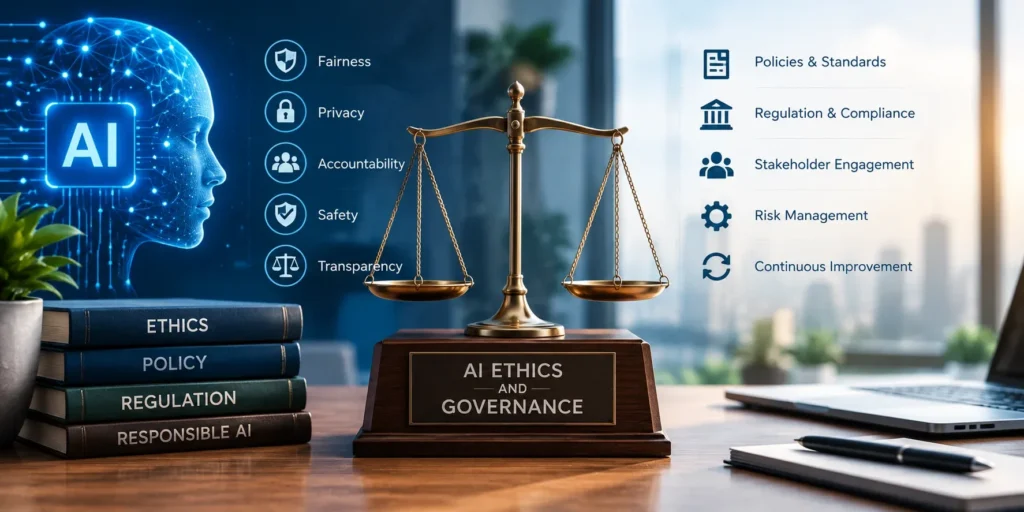
Introduction
Every organization deploying AI eventually hits the same wall: a principle sounds right on a slide, but nobody can say who is accountable when the system gets it wrong. That gap between stated values and enforceable practice is exactly what AI ethics and governance are supposed to close. It’s also where most programs quietly fail, not because leaders disagree on values, but because nobody built the operational machinery to act on them.
This guide walks through what AI ethics and governance actually mean, why global institutions and enterprises keep converging on the same core principles, what a working governance framework looks like in practice, and the failure patterns that show up again and again across industries when governance is treated as an afterthought.
Quick Answer
AI ethics is the set of values and principles fairness, transparency, human oversight, non-discrimination that define what “good” AI looks like. AI governance is the operational machinery policies, roles, audits, escalation paths that makes those values enforceable inside a real organization. You need both: ethics without governance is a poster on the wall; governance without ethics is a compliance checkbox with no direction. In the failure patterns discussed later in this guide, the recurring issue usually isn’t a missing value statement it’s a missing owner, a missing escalation path, or a missing “no” that should have been said earlier.
Key Insights
- Global soft-law standards (like UNESCO’s 2021 Recommendation) and enterprise frameworks are converging on a similar core: human oversight, transparency, accountability, and harm prevention.
- Governance failures tend to follow a recognizable pattern a team identifies a risk internally, escalates it, and then the organization stalls because no one has clear decision rights to act.
- In some jurisdictions and cases, boards are being viewed as bearing greater accountability for AI oversight, drawing on legal reasoning from earlier corporate risk failures involving director duty though this is an evolving area of law, not a settled universal standard.
- Waiting for “AI to mature” before building governance is backward the organizations with the least mature AI programs are often the most exposed, because they have rapid adoption without matching controls.
- Ethics and governance work is lagging AI adoption by a meaningful margin inside most enterprises, which is precisely the gap that produces headline-making failures.
Why This Topic Matters Right Now
AI adoption inside organizations has outpaced the governance structures meant to manage it. Teams across departments not just engineering are using AI tools daily, often without formal sanction or oversight. That gap between usage and oversight is where liability accumulates quietly: a biased hiring model that nobody stress-tested, a customer-facing chatbot that gives incorrect information nobody fact-checked, a report built partly on AI output that nobody disclosed.
None of these are exotic, futuristic risks. They are ordinary operational risks that existing governance structures were never designed to catch, because those structures assumed a human made every consequential decision. AI ethics and governance work is the process of rebuilding that assumption for a world where AI systems make or heavily influence decisions that used to require a person.
What AI Ethics and Governance Actually Mean
The two terms get used interchangeably, which causes real confusion in planning meetings and in vendor pitches alike. It helps to separate them cleanly before building anything on top of them.
| Dimension | AI Ethics | AI Governance |
| Nature | Normative what should happen | Structural what does happen |
| Output | Principles, values, commitments | Policies, roles, audit trails |
| Owner | Often ethics/compliance leadership | Cross-functional (legal, risk, tech, ops) |
| Enforcement | Cultural, aspirational | Procedural, auditable |
| Example | “AI should not discriminate” | “Every model is bias-tested before launch, signed off by a named reviewer” |
| Failure mode | Vague, unenforceable ideals | Bureaucracy without ethical direction |
Neither one works alone. A company can publish a beautifully worded AI ethics charter and still ship a biased hiring model if nobody owns the testing process that would have caught it. Conversely, a company can have rigorous multi-step approval workflows and still produce harmful outcomes if the underlying principles guiding those workflows were never clearly defined in the first place the process becomes a rubber stamp rather than a genuine check.
The practical implication: when you’re evaluating your own organization’s AI maturity, ask two separate questions. First, do we have a clear, specific position on what we consider acceptable AI behavior? Second, is there a person, team, or committee whose job it is to verify that position is actually being followed before something ships? Most organizations can answer the first question. Far fewer can answer the second with a name.
AI Ethics vs. Responsible AI vs. AI Governance
A third term “Responsible AI” gets thrown into the mix constantly, usually as a catch-all, which blurs a distinction worth keeping clear. Here’s how the three relate rather than overlap:
- AI Ethics is the philosophical layer the values and principles themselves (fairness, transparency, human oversight). It answers “what do we believe is right?”
- Responsible AI is the practice layer the applied engineering and design discipline of building systems that reflect those values: bias testing, model documentation, red-teaming, accessible design. It answers “how do we build it right?”
- AI Governance is the structural layer the organizational scaffolding (roles, policies, board oversight, audit trails) that makes the other two enforceable and consistent across an entire organization, not just within one team’s good intentions. It answers “who makes sure it’s actually done right, every time?”
A useful way to see how they nest: an organization’s ethics might state that AI decisions must be explainable. Responsible AI practice is the technical work of actually producing explainability documentation for a given model. AI governance is the policy that says no model ships without that documentation being reviewed and signed off by someone outside the team that built it. Remove any one layer and the other two lose most of their force values without applied practice stay abstract, and applied practice without governance stays inconsistent from team to team.
The Global Foundation: Principles Everyone Is Converging On
In November 2021, UNESCO’s member states adopted the first global standard for AI ethics, built around four core values: respecting human rights and dignity, fostering peaceful and interconnected societies, ensuring diversity and inclusiveness, and supporting environmental sustainability. From those four values, UNESCO derived ten specific operating principles, which stated in full are: (1) proportionality and do-no-harm, (2) safety and security, (3) right to privacy and data protection, (4) multi-stakeholder and adaptive governance and collaboration, (5) responsibility and accountability, (6) transparency and explainability, (7) human oversight and determination, (8) sustainability, (9) awareness and literacy, and (10) fairness and non-discrimination. That original ten-item list belongs to UNESCO specifically, as part of a single, formally adopted intergovernmental document.
A note on the seven-theme list below: rather than simply restate UNESCO’s ten principles, the list further down is a separate synthesis a consolidation of overlapping themes found not just in UNESCO’s Recommendation but also across independent enterprise governance models and academic/multi-stakeholder research frameworks. Some UNESCO items are combined here (for example, UNESCO’s “responsibility and accountability” and “human oversight and determination” are treated together under one broader accountability theme), while “awareness and literacy” and “sustainability” are folded into surrounding themes rather than listed separately, since they function more as supporting conditions than as standalone operational controls in most enterprise frameworks reviewed. The point of this synthesis isn’t to replace UNESCO’s list it’s to show what tends to survive translation into practice once multiple independent sources are compared side by side.
What’s genuinely notable is how consistently a similar set of ideas reappears across frameworks developed independently of one another academic research centers, national regulators, and enterprise consultancies keep converging on overlapping pillars, even when their starting points and vocabulary differ. That convergence isn’t a coincidence; it reflects the fact that the underlying risks of AI systems (bias, opacity, unaccountable decision-making, safety failures) are the same regardless of who is writing the framework.
The seven consolidated themes that show up most consistently once these sources are compared are:
- Proportionality and harm prevention don’t deploy more capability, autonomy, or data access than the task genuinely requires. Risk assessment should scale with the stakes of the decision the AI is making.
- Transparency and explainability people affected by an AI-influenced decision should be able to understand, at some meaningful level, why it was made. The appropriate depth of explanation varies by context, but the principle doesn’t.
- Human oversight and accountability a human retains ultimate responsibility for outcomes, and consequential automated decision paths should be traceable back to a documented process and a named party; the system itself is never treated as the responsible actor.
- Fairness and non-discrimination this means actively testing for and correcting bias, not merely avoiding an intent to discriminate. Disparate impact can occur even without discriminatory intent.
- Privacy and data protection protected throughout the entire AI lifecycle, from training data collection through deployment and eventual retirement of a model, not just at the point of initial data collection.
- Multi-stakeholder governance meaningful input from technical, legal, and affected-community perspectives, not engineering judgment alone deciding what counts as acceptable risk.
- Safety and security addressing both unintended harms and vulnerability to deliberate misuse or attack, treated as a distinct concern from fairness or privacy.
This convergence matters practically because it means an organization doesn’t need to invent its ethical position from scratch, and doesn’t need to wait for perfect regulatory clarity to start. While terminology and emphasis still vary meaningfully across frameworks and debate continues on implementation details, tradeoffs, and edge cases there’s a reasonable degree of high-level agreement on which broad values matter, with UNESCO’s ten principles standing as the most authoritative reference point. The harder, less-resolved work ahead is translating those broadly shared values into specific, enforceable, and auditable controls inside a specific organization’s workflows.
From Principles to Practice: A Three-Layer Governance Framework
This is where most organizations get stuck. They have a values statement. They may even have a slide with the seven themes listed above. What they don’t have is an operating model that tells a product manager, on a Tuesday afternoon, exactly what to do before shipping a new AI feature. Rather than a flat checklist, it’s more useful to think of the framework as three layers stacked on top of each other structure, standards, and posture each depending on the one beneath it.
Layer 1: Structure who is actually in the room
Two things need to be true before any standard or policy means anything: someone senior enough must own the outcome, and the review can’t happen inside a single silo.
That starts with cross-functional ownership. AI governance consistently fails when it’s treated as purely a technical problem or purely a legal one. Effective programs pull legal, risk, engineering, product, and operations into a shared review process, so a model isn’t approved by engineering in isolation, and isn’t reflexively blocked by legal without understanding the technical tradeoffs. Surfacing tradeoffs together, early, is far cheaper than discovering conflicting priorities after launch, when the cost of reversal is much higher.
That cross-functional group needs somewhere to escalate to, which is where senior and, ideally, board-level visibility comes in. This doesn’t have to mean a brand-new standalone board committee on day one plenty of organizations start by adding AI as a standing agenda item on an existing risk or audit committee. What matters is that AI risk has a clear line of visibility running up to the most senior decision-makers, not that it stays contained inside engineering. Some governance practitioners point to how board duty has been interpreted in unrelated high-risk industries as a signal that this kind of senior visibility may carry more legal weight over time, though how that plays out for AI specifically is still an open and evolving question.
Layer 2: Standards what “acceptable” actually means in writing
With the right people at the table, the next requirement is a written standard that removes ambiguity about what gets approved. This is comparable to how the professions of medicine and law operate under enforceable codes of conduct: abstract principles get translated into specific, checkable requirements minimum bias-testing thresholds before launch, required explainability documentation for consequential decisions, defined data retention limits, and clear escalation triggers that specify exactly what circumstances require pausing a launch. Without this layer, cross-functional review just becomes a meeting where people argue from first principles every single time, which doesn’t scale past the first few reviews.
Layer 3: Posture staying ahead instead of catching up
The final layer is less about any single decision and more about the organization’s overall stance over time. Two habits define it. First, building in a compliance buffer: meeting the legal minimum is not the same as being safe, and regulation consistently lags behind the pace of AI deployment by a meaningful margin, so organizations with the strongest track records build in safeguards beyond what current regulation strictly requires. Second, treating monitoring as continuous rather than a one-time gate: a model that passes review at launch can still drift into unsafe or unfair behavior as underlying data and usage patterns change, so ongoing monitoring sometimes described in governance literature as “prudent vigilance” treats initial approval as the start of an accountability relationship, not its conclusion. Together, these reframe a binary “ship or don’t ship” decision into a continuous “ship, then watch, then adjust” cycle that better matches how AI systems actually behave once they’re in production.
The AI Governance Lifecycle
The three-layer framework above describes who is responsible for governance and what they’re checking for. It’s equally important to map when governance activities actually happen, because most gaps occur at the handoff points between stages, not within any single stage. A working lifecycle typically has six checkpoints:
- Design and intake. Before development starts, the intended use case, affected population, and risk tier are documented. High-risk use cases (anything affecting employment, credit, healthcare, or legal outcomes) get flagged for deeper review at every later stage.
- Data sourcing and preparation. Training and fine-tuning data is reviewed for consent, provenance, and representativeness. This is where privacy obligations and early bias risks are usually introduced, often invisibly, if this step is skipped.
- Development and testing. Bias testing, safety testing, and explainability documentation are produced here not as a final gate, but as an ongoing part of building the system, so problems surface while they’re still cheap to fix.
- Pre-launch review and sign-off. The cross-functional review described earlier happens formally at this checkpoint: legal, risk, product, and engineering sign off together, with a named individual accountable for the final decision.
- Deployment and disclosure. The system goes live, with any required user-facing disclosure about AI involvement built in from day one rather than added reactively later.
- Monitoring, retraining, and retirement. Performance and fairness metrics are tracked on an ongoing basis; the system is retrained, adjusted, or formally retired if drift, misuse, or changing regulation make the original approval no longer valid.
Treating these as six discrete checkpoints, each with a named owner and a clear artifact (a document, a sign-off, a metric dashboard), is what turns “we have an AI governance framework” from an aspiration into something an auditor, regulator, or new hire could actually walk through step by step.
Real-World Failure Patterns (and What They Teach)
Across sectors finance, government services, consulting, and travel, among others three recurring failure patterns show up again and again. Recognizing the pattern is often more useful than memorizing any specific incident, because the underlying structural gap is what repeats.
The stalled escalation. A team identifies a bias or safety issue internally during testing and escalates it upward for a decision. Leadership can’t reach consensus quickly enough, so the flawed system either ships anyway under deadline pressure or stays live because reversing course feels disruptive. The structural lesson: governance needs a default action built in typically “pause, don’t ship” for situations where consensus isn’t reached in a reasonable timeframe. A governance process without a default is really just a process for indefinite delay disguised as deliberation.
The undisclosed AI use. An organization delivers a work product a report, an analysis, a recommendation without disclosing that AI played a significant role in producing it. The output later turns out to contain fabricated details that would have been caught sooner had the AI involvement been flagged for extra scrutiny. The structural lesson: disclosure isn’t a courtesy extended to clients or the public it’s the mechanism that allows errors to be caught before they compound into a larger failure.
The “AI did it” defense. A company facing legal or regulatory scrutiny for an AI system’s harmful output argues that the system acted as an independent agent, and that the company shouldn’t bear full liability as a result. In the cases that have tested this argument publicly so far, courts and regulators have generally been unreceptive to it. The structural lesson organizations tend to draw from this: it’s prudent to plan around accountability sitting with the deploying organization rather than the tool, since betting on the opposite outcome has not held up well in practice to date.
Comparison: Global Frameworks at a Glance
| Framework | Type | Scope | Best For |
| UNESCO Recommendation on the Ethics of AI | Global soft-law standard | 193 member states | Setting a values baseline; policy alignment; government and cross-border coordination |
| Enterprise governance models (e.g., “Boundaries of Tolerance”) | Corporate operating framework | Individual organizations | Translating principles into board and executive-level practice; internal accountability structures |
| Academic & multi-stakeholder research initiatives | Research and policy advocacy | Cross-national, cross-disciplinary | Longer-term AI safety research; international cooperation; capacity-building for developing regions |
Each layer serves a different function, and mature organizations typically draw from all three: the global standard for a defensible values baseline, the enterprise framework for day-to-day operating discipline, and ongoing research for staying ahead of emerging risks that haven’t yet been codified anywhere.
AI Governance Framework Template
Everything above is easier to apply once it’s condensed into a single working artifact. The table below maps each lifecycle checkpoint to a required action, a named owner role, and the evidence that should exist afterward the kind of format a real AI governance committee could adopt directly as a review checklist or audit trail.
| Governance Stage | Required Action | Owner | Evidence Produced |
| Design & Intake | Classify use case by risk tier; document affected population | AI Governance Lead | Risk classification form |
| Data Sourcing | Check data consent, provenance, and representativeness | Legal / Data Team | Data provenance review |
| Development & Testing | Run bias and safety testing before launch | Engineering | Test report with pass/fail thresholds |
| Pre-Launch Approval | Cross-functional sign-off; named decision owner | AI Governance Committee | Signed approval record |
| Deployment | Disclose AI involvement to affected users by default | Product | Disclosure copy / UI text |
| Monitoring & Retirement | Track performance and fairness drift; retrain or retire as needed | Risk Team | Periodic monitoring report |
Treat each row as non-optional rather than aspirational: if a stage has no named owner or no evidence artifact, that’s the specific gap to close first, not a detail to fill in later. A template like this is also what turns an internal AI ethics conversation into something that survives a regulator’s or auditor’s request to “show your work.”
Common Mistakes Organizations Make
- Treating AI governance as a one-time compliance sign-off rather than a continuous, living process that adapts as systems and usage evolve.
- Housing AI ethics entirely inside the legal function or entirely inside engineering, instead of building genuine cross-functional ownership from the start.
- Waiting for regulation to explicitly mandate a safeguard before implementing it, rather than building a proactive compliance buffer ahead of legal requirements.
- Failing to define, in writing, who has the authority to say “no” or “pause” when a risk is flagged leaving that authority ambiguous until a crisis forces the question.
- Disclosing AI involvement in a work product only after a failure surfaces publicly, rather than making disclosure the default practice from day one.
- Assuming a small team or startup is too early-stage to need any governance structure, when even a lightweight version meaningfully reduces exposure.
Best Practices Checklist
- Establish a named, board-level AI oversight function distinct from general technology governance.
- Map your existing practices against an established principle set, such as the UNESCO ten principles, to identify concrete gaps.
- Require documented bias and safety testing before any consequential model ships to production.
- Build a clear, fast escalation path with a default-safe outcome built in for unresolved disagreements.
- Treat monitoring as an ongoing responsibility rather than a one-time launch gate that’s checked and forgotten.
- Disclose AI use by default in any output that materially affects decisions about real people.
- Revisit your governance framework on a fixed schedule, not only when an incident forces a review.
Conclusion
The organizations that get AI ethics and governance right treat it as infrastructure, not decoration a board-level responsibility, a cross-functional habit, and a continuously monitored process, rather than a values statement published once and quietly forgotten. There’s meaningful, if imperfect, overlap in the high-level principles referenced across independent global sources, even though terminology and emphasis still differ from one framework to the next. What separates organizations that manage AI risk well from those that end up in the next case study isn’t usually a disagreement over values it’s whether someone has clearly answered three operational questions in advance: who owns the decision, what the default action is when something looks wrong, and how quickly the organization can actually act once a concern is raised. Getting those three answers right, in writing, before you need them, is the real work of AI governance.
FAQs
What’s the difference between AI ethics and AI governance?
AI ethics defines the values a system should uphold fairness, transparency, human oversight, and similar principles. AI governance is the operational structure policies, named roles, and audit processes that enforces those values in day-to-day practice. One sets the direction; the other makes sure the organization actually travels in it.
Who is legally responsible when an AI system causes harm?
This is still an evolving area of law and can depend on jurisdiction and the specifics of the case. That said, in the notable cases so far, regulators and courts have generally leaned toward holding the deploying organization responsible for outcomes rather than accepting that an AI system can be treated as an independently liable actor. Organizations are generally better served by planning as though legal responsibility will stay with the humans and organizations that built, deployed, or approved the system, rather than assuming otherwise.
Is there a single global AI ethics standard?
The closest thing is UNESCO’s Recommendation on the Ethics of Artificial Intelligence, adopted by 193 member states in 2021. It functions as a normative, widely-referenced standard rather than binding law in most jurisdictions, but it has strongly influenced how national and enterprise frameworks are subsequently written.
Do small companies need a formal AI governance framework?
Yes, scaled appropriately to size. Even a lightweight version a single named owner, a basic pre-launch review checklist, and a documented escalation step for flagged concerns meaningfully reduces risk compared to having no structure at all, and it’s far easier to build early than to retrofit after an incident.
How often should AI systems be re-audited after launch?
There’s no single universal number that applies across every use case, but best practice ties re-audits to meaningful changes in underlying data, usage patterns, or model updates, combined with a minimum periodic review on a fixed schedule regardless of whether anything appears to have changed.
What happens if an organization only focuses on ethics without building governance?
The values end up unenforceable. Teams may genuinely agree with the stated principles but have no consistent process for checking whether a specific system actually meets them before it ships, which means good intentions don’t reliably translate into good outcomes.