Quick Answer
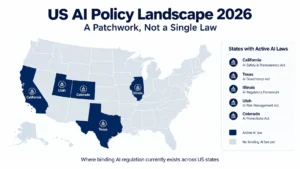
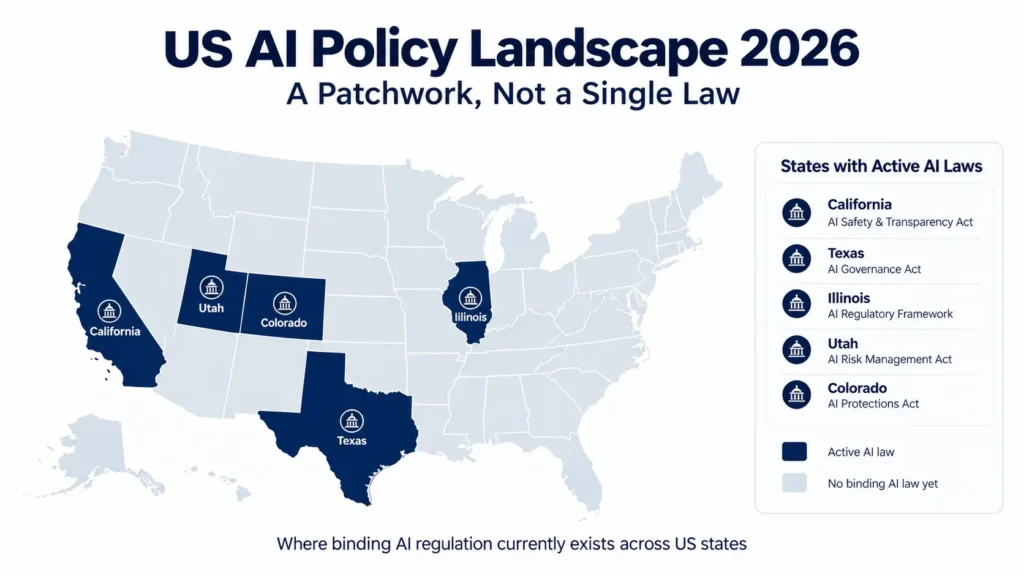
ai policy news As of July 2026, there is still no single comprehensive federal AI law in the United States policy runs through a mix of executive actions and a patchwork of state laws, with California, Texas, Illinois, and Utah already in force and Colorado’s rules pushed to January 2027. The EU AI Act remains the world’s clearest comprehensive AI framework and continues rolling out through 2026. The UK is sticking with a principles-based, regulator-led approach rather than a single AI statute. Meanwhile, Congress is actively moving on AI legislation, with a major bipartisan federal framework proposal introduced in June 2026.
Key Insights
- The US has no single AI law yet — binding rules mostly come from state legislatures, not Congress.
- The EU AI Act is still the global reference point for comprehensive AI regulation.
- The UK continues favoring guidance and cross-regulator coordination over new legislation.
- A bipartisan federal AI governance bill (GAAIA) was introduced in Congress in June 2026 — a signal, not yet law.
- Regulators are increasingly treating AI as infrastructure requiring safety and explainability by design, not paperwork added after launch.
United States: A Patchwork, Not a Single Law
As of mid-2026, the US still lacks one comprehensive federal AI statute. Instead, the policy landscape is built from two layers: executive branch action setting broad priorities, and individual state legislatures creating the actual binding rules businesses have to follow.
On the federal side, June 2026 brought a notable executive order directing AI-enabled cyber defense work and a voluntary industry cybersecurity clearinghouse. Separately, Congress has been more active than headlines suggest — in late June 2026, the House Science, Space, and Technology Committee advanced ten AI-related bills in a single session, nearly all passing unanimously. These bills touch AI research infrastructure, security, workforce development, and data governance, and lean heavily on agencies like NIST and the National Science Foundation to eventually define technical standards. None of these bills impose sweeping regulatory requirements yet, but they lay groundwork that could shape future federal rules.
The most significant recent federal development is the Great American Artificial Intelligence Act (GAAIA) — a 269-page bipartisan discussion draft introduced by Representatives Jay Obernolte and Lori Trahan. It’s the first comprehensive federal AI governance framework proposed in Congress. Being a “discussion draft” matters here: it signals serious bipartisan intent, but it is not law, and businesses should treat it as a preview of where federal policy could head rather than a compliance requirement today.
State Law Is Where the Real Deadlines Are
For most businesses, the binding obligations right now sit at the state level, not the federal level:
- California, Texas, Illinois, and Utah already have AI-related rules in force.
- California’s AI Transparency Act becomes operative on August 2, 2026.
- Colorado repealed and reenacted its original AI Act under SB 26-189, signed May 14, 2026 — pushing core automated-decision-making duties from their original June 2026 date to January 1, 2027.
The practical guidance from compliance trackers is consistent: treat the federal preemption conversation as unresolved noise, and continue building toward each state’s actual binding dates rather than assuming national rules will override them anytime soon.
European Union: Still the Global Reference Point
The EU AI Act remains the most comprehensive AI law in force anywhere in the world, and July 2026 brought further implementation movement rather than a new law. The EU Council formally approved changes to the AI Omnibus timetable, and the European Commission issued practical guidance on transparency requirements for AI-generated content, alongside a new cybersecurity action plan. The EU is also investing further in AI infrastructure through its “AI Factories” programme and has launched a Grand Challenge focused specifically on AI for cybersecurity.
For businesses operating in or selling into the EU, the throughline is consistency: the Act’s core structure hasn’t changed, but the implementation details — especially around transparency for AI-generated content — continue to get filled in through Commission guidance.
United Kingdom: Guidance Over Legislation
The UK continues to resist a single, dedicated AI statute, instead favoring a principles-based approach coordinated across existing regulators. In June 2026, the UK government launched an “AI Growth Lab,” bringing together regulators including the ICO, the Solicitors Regulation Authority, and the Legal Services Board to provide practical guidance for organizations deploying AI — with an initial focus on legal services and conveyancing.
Separately, the UK’s Financial Conduct Authority published the Mills Review in early July 2026 — described as the first review of its kind conducted by any financial regulator globally — examining how AI could reshape retail financial services by 2030. One of the more consequential open questions the review raises: the FCA’s regulatory perimeter is built around specific regulated activities, not technologies, which means general-purpose AI tools helping consumers with savings or borrowing decisions may currently sit outside the regime even when they function very similarly to financial advice.
Other Jurisdictions to Watch
AI policy activity isn’t limited to the US, EU, and UK. South Africa, for example, has a Draft National Artificial Intelligence Policy under consideration, aiming to guide AI adoption around inclusive economic growth, job creation, and localized ethical standards — including provisions for digitizing and translating content across the country’s official languages. It’s a useful reminder that AI governance conversations are happening globally, not just in the handful of jurisdictions that dominate policy headlines.
Why This Matters Beyond the Legal Department
AI policy has stopped being a topic that only legal teams need to track. Founders, product teams, and marketers building or deploying generative AI tools, automated decision systems, or AI-driven customer interactions are increasingly expected to bake safety, explainability, and accountability into product design from day one — not retrofit compliance after launch. Regulators across multiple jurisdictions are converging on this same expectation, even where their specific legal mechanisms differ sharply.
Real-World Impact
- SaaS and startup teams now need to track jurisdiction-specific effective dates, not just “AI regulation” broadly, since binding obligations vary state by state and country by country.
- Financial services firms face a genuinely open question in the UK about whether general-purpose AI advice tools fall inside or outside existing regulatory perimeters.
- Legal and professional services are seeing early, government-backed AI adoption support, as seen in the UK’s AI Growth Lab initiative.
- Global businesses need to prepare for continued regulatory divergence rather than convergence, at least in the near term.
Comparison Table: AI Policy Status by Jurisdiction (as of July 2026)
| Jurisdiction | Approach | Status | Key Development |
| United States (Federal) | Executive action + pending legislation | No comprehensive law | GAAIA discussion draft introduced June 2026 |
| United States (States) | State-by-state statutes | Binding, varies by state | California AI Transparency Act effective Aug 2, 2026 |
| European Union | Comprehensive statute | In force, rolling implementation | AI Omnibus timetable approved July 2026 |
| United Kingdom | Principles-based, regulator-led | No single AI statute | FCA Mills Review published July 2026 |
| South Africa | National policy framework | Draft stage | Draft National AI Policy under consideration |
Key Takeaways
- The global AI policy landscape remains fragmented — there is no single “AI law” businesses can point to across jurisdictions.
- US federal movement is real but not yet binding; state law is where actual compliance deadlines live.
- The EU AI Act remains the clearest full framework, with implementation details still being filled in through 2026.
- The UK is betting on regulator coordination over new legislation, but that leaves some gray areas, like general-purpose AI financial tools.
Common Mistakes to Avoid
- Assuming a federal AI law exists or is imminent in the US — it isn’t, and discussion drafts like GAAIA are not enforceable yet.
- Ignoring state-level deadlines while waiting for federal clarity, which can leave businesses non-compliant with binding state rules.
- Treating the EU AI Act as a “set it and forget it” framework, when implementation guidance is still actively evolving.
- Overlooking that AI policy is a genuinely global conversation, not just a US/EU/UK story.
Best Practices for Staying Current
- Track policy by jurisdiction and effective date, not by headline — “AI regulation” news often blends binding law with early-stage proposals.
- Build AI product and compliance reviews around the strictest applicable jurisdiction’s requirements, rather than the most lenient.
- Revisit your compliance posture at least monthly, given how frequently new guidance and bills are introduced.
- Distinguish clearly, internally, between “law today,” “law confirmed for a future date,” and “proposed but not enacted.”
Conclusion
AI policy in 2026 is defined less by any single landmark law and more by parallel, uneven progress across jurisdictions binding state statutes in the US, a maturing comprehensive framework in the EU, regulator-led guidance in the UK, and early-stage national policy drafts elsewhere. For businesses building with AI, the safest approach isn’t waiting for a single global standard to emerge — it’s tracking the specific, dated obligations that actually apply to where you operate, and building toward the strictest of them now.
FAQs
Is there a federal AI law in the United States?
No. As of July 2026, the US has no single comprehensive federal AI statute. Policy runs through executive actions and a patchwork of state laws, though a bipartisan federal framework (GAAIA) has been introduced as a discussion draft.
What is the EU AI Act’s current status?
It remains in force as the world’s most comprehensive AI law, with the EU Council and Commission continuing to roll out implementation guidance, including recent updates to transparency requirements for AI-generated content.
Does the UK have an AI law?
No single AI statute. The UK relies on existing regulators applying AI-specific guidance within their own remits, coordinated through initiatives like the AI Growth Lab.
When does California’s AI Transparency Act take effect?
It becomes operative on August 2, 2026.
What happened to Colorado’s AI Act?
It was repealed and reenacted under SB 26-189 in May 2026, pushing core automated-decision-making duties to January 1, 2027, instead of the original June 2026 date.