Quick Answer
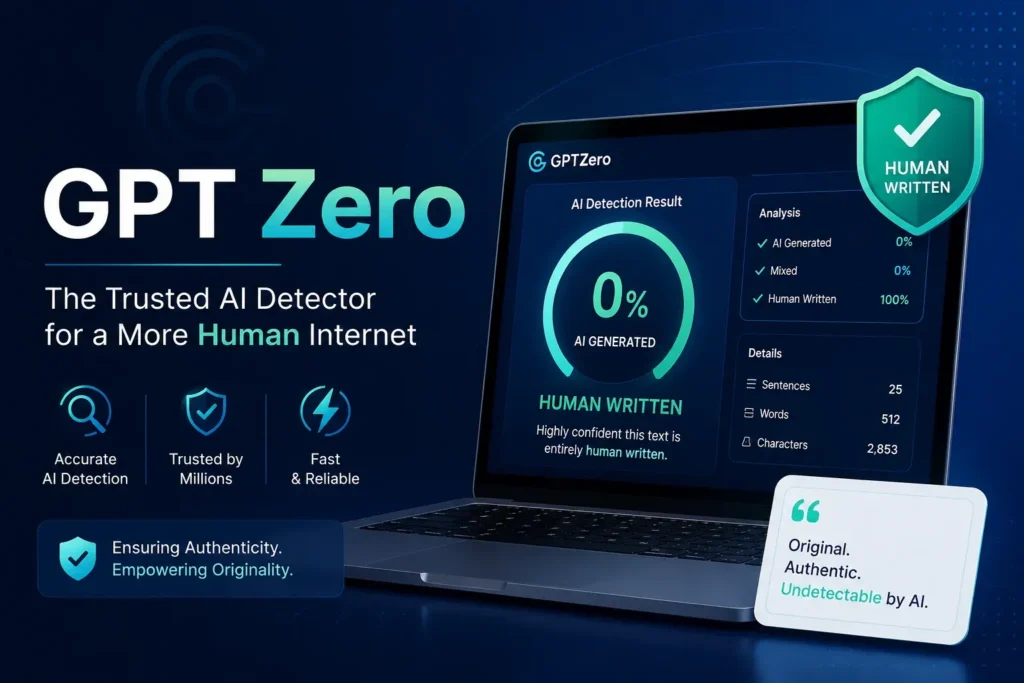
GPTZero is an AI content detector, founded by Princeton student Edward Tian in January 2023, that estimates whether text was written by a human or generated by a model like ChatGPT, Claude, or Gemini<cite index=”4-1″>by analyzing text and estimating how likely the writing is to be AI-generated, human-written, or a mix of the two, returning sentence-level highlighting</cite>. As of June 2026, it’s no longer an independent company: <cite index=”3-1″>GPTZero was acquired by Superhuman, the company behind Grammarly, with its roughly 30-person team joining to lead authenticity work and its detection technology being built into Superhuman Go</cite>. It’s still operating as a standalone product, with plans ranging from a free tier to paid tiers with higher word limits.
Independent testing in 2026 puts its real-world accuracy well below its own marketing claims — commonly in the 62%–91% range depending on content type — with false positive rates on genuinely human-written text landing anywhere from roughly 9% to 18%.
Key Insights
- It’s owned by Grammarly’s parent company now. This is the single biggest 2026 development and the thing most existing GPTZero content hasn’t caught up to yet.
- The accuracy number depends entirely on which test you trust. Controlled benchmark testing shows 99%+; independent real-world testing shows 62–91%. Both are “true” — they’re measuring different things.
- False positives are the real risk, not false negatives. A detector wrongly flagging a human’s original work carries higher real-world stakes (a failed assignment, a lost freelance client) than it missing some AI text.
- It performs unevenly across AI models. It’s strongest on raw, unedited GPT-4-family text and measurably weaker on Claude and Gemini output.
- Paraphrased or “humanized” AI text is its biggest blind spot, with accuracy reported dropping sharply on edited AI content.
What Is GPTZero? (Definition)
GPTZero is an AI content detection tool that analyzes a piece of writing and returns a probability score estimating whether it was generated by an AI language model, written entirely by a human, or a mix of both, using signals like perplexity and burstiness alongside sentence-level highlighting to show which passages influenced the score.
<cite index=”2-1″>It was created by Princeton University student Edward Tian and launched in January 2023, just months after ChatGPT’s November 2022 release</cite>, making it one of the first mainstream tools of its kind.
The Grammarly/Superhuman Acquisition, Explained
<cite index=”3-1″>GPTZero grew from its 2023 launch to roughly 19 million users and about $30 million in annual recurring revenue</cite> before <cite index=”3-1″>Superhuman announced its acquisition of the company on June 23, 2026</cite>. <cite index=”3-1″>The service continues operating as a product, and it is still shipping updates</cite> — it has not been shut down or folded into another tool under a different name. For now, that mainly means backing from a much larger company (Grammarly is one of the most widely used writing tools in the world) and a stated direction toward embedding authenticity detection into Superhuman’s broader product line, rather than an immediate change to how the standalone GPTZero product works.
What this likely means going forward, based on how acquisitions of this type typically play out (this part is informed prediction, not confirmed fact): tighter integration with Grammarly’s writing tools, more resources for model training, and — over a longer horizon — the possibility of GPTZero’s detection becoming a built-in feature elsewhere rather than a separate destination. None of that has been officially detailed yet, so treat it as a reasonable expectation rather than a settled roadmap.
How GPTZero Detection Actually Works
GPTZero uses a layered approach rather than a single signal:
- Perplexity analysis — measures how statistically predictable each word choice is given its context. AI-generated text tends to be low-perplexity (more predictable); human writing tends to be higher-perplexity (more surprising word choices).
- Burstiness measurement — checks variation in sentence length and structure. Human writing tends to alternate between short and long sentences unevenly; AI output tends to be more uniform.
- Deep learning classifiers trained on labeled human vs. AI text samples, layered on top of the statistical signals to produce a final probability.
- Sentence-level highlighting that shows which specific passages pushed the score toward “AI” or “human,” rather than returning a single opaque number.
The output is typically presented in three bands: likely human, mixed (roughly 30–90% probability), and likely AI-generated (above roughly 90% probability), rather than a hard binary pass/fail.
Is GPTZero Accurate? Full Explanation
This is where the honest answer gets complicated, and where most coverage oversimplifies.
The vendor-reported number
<cite index=”1-1″>GPTZero scored 99.5% accuracy on a University of Chicago Booth School of Business benchmark conducted in February 2026, tested against GPT-4.1, Claude Opus 4, Claude Sonnet 4, and Gemini 2.0 Flash</cite> — the highest of any detector in that particular test.
The independent-testing numbers
Multiple separate outlets ran their own tests in 2026 with notably different, lower results:
- <cite index=”1-1″>One independent test across 2,400 mixed samples in February 2026 found real-world accuracy of 87% with a 10% false positive rate</cite>.
- <cite index=”6-1″>A separate test of 200 mixed samples found an 83% detection rate for AI text and an 11% false-positive rate on human-written text</cite>, with <cite index=”6-1″>88% accuracy on GPT-4 text specifically but only 76% on Claude 3.5 text</cite>.
- <cite index=”8-1″>A 500-sample independent test put overall accuracy at 88%</cite>, with <cite index=”8-1″>false positive rates ranging from roughly 9% to 18% depending on the writer’s background</cite> — a detail worth sitting with, since it suggests the tool doesn’t fail evenly across all writers.
- <cite index=”7-1″>A broader aggregation of independent studies in March 2026 put real-world accuracy between 62% and 88%</cite>, <cite index=”7-1″>with accuracy on paraphrased or “humanized” AI text dropping as low as roughly 40%</cite>.
Why the numbers don’t agree
These aren’t contradictory so much as they’re measuring different scenarios:
| Test condition | Typical reported accuracy |
| Clean, unedited AI text (raw GPT-4 output) | ~99% |
| Mixed human/AI real-world samples | 83–91% |
| Claude-generated text specifically | 76–95% (wide range) |
| Paraphrased or “humanized” AI text | As low as ~40% |
The takeaway: treat any single “GPTZero is X% accurate” headline with suspicion unless it specifies the test conditions. Controlled benchmarks using clean AI text will always outperform real-world testing on mixed, edited, or paraphrased writing.
Real-World Use Cases
- Educators scanning student submissions and using the Writing Report and sentence-level highlighting as a conversation-starter rather than an automatic penalty.
- Publishers and editors doing a baseline authenticity check on freelance or contributor submissions before publication.
- Businesses using the AI Detection API to screen user-generated content or vet vendor-submitted copy at scale.
- Individual writers and students proactively checking their own original work before submission, to catch false-positive risk ahead of time.
Examples
- A professor uses GPTZero’s sentence-level highlighting to open a conversation with a student about a flagged paragraph rather than issuing an automatic failing grade — <cite index=”1-1″>a workflow the tool’s own positioning is explicitly built around, supporting discussion rather than binary pass/fail judgments</cite>.
- A freelance writer for whom English is a second language runs a completed article through GPTZero before sending it to a client, specifically because ESL writing patterns are one of the documented false-positive risk factors.
- A content team uses the API to batch-screen a backlog of vendor-submitted articles as a first-pass authenticity filter, understanding it as a screening signal rather than a final verdict.
Pros & Cons
| Pros | Cons |
| <cite index=”3-1″>Large, established user base (~19 million users) and the most widely adopted detector in education</cite> | Real-world accuracy meaningfully lower than headline benchmark claims |
| Generous free tier (10,000 words/month, no card required) | False positive rate on human text (~9–18%) carries real academic and professional risk |
| Sentence-level highlighting instead of a single opaque score | Weaker and less consistent on Claude and Gemini output than on GPT-4 text |
| Now backed by Grammarly’s resources post-acquisition | Accuracy drops sharply on paraphrased/”humanized” AI text |
| Dedicated educator tools (Writing Report, Chrome extension) | Pricing across third-party listings is inconsistent — always verify on the official site |
GPTZero vs. Other AI Detectors (Comparison Table)
| Detector | Best For | Reported Accuracy (2026) | Free Tier |
| GPTZero | Educators, general-purpose detection | 62–99% depending on test conditions | Yes — 10,000 words/month |
| Originality.ai | Content marketers, paraphrased/humanized content | <cite index=”1-1″>96.7% on paraphrased content vs. GPTZero’s 68%</cite> | Limited |
| Turnitin | Institutional plagiarism + AI checks | <cite index=”1-1″>Some universities have stopped using Turnitin’s AI detector over accuracy concerns</cite> | Institutional license only |
| ZeroGPT | Quick free checks | <cite index=”6-1″>Weaker than GPTZero and other paid tools in independent mixed-content testing</cite> | Yes, free |
Bottom line: GPTZero leads on accessibility and educator-specific features; specialist tools like Originality.ai currently outperform it specifically on paraphrased/humanized text.
Pricing (Verify on Official Site — Figures Vary by Source)
Third-party pricing listings for GPTZero disagree with each other by several dollars per tier, which is itself worth flagging rather than picking one number and presenting it as fact. Across the most recent and most detailed sources, the pricing structure is roughly:
| Plan | Monthly (billed monthly) | Monthly (billed annually) | Word allowance |
| Free | $0 | $0 | ~10,000 words/month |
| Essential | ~$14.99 | ~$8.33–$8.99 | ~150,000 words/month |
| Premium | ~$23.99 | ~$12.99 | ~300,000 words/month |
| Professional | ~$45.99 | ~$24.99 | ~500,000 words/month |
| Team / Enterprise / API | Custom quote | Custom quote | Negotiated volume |
Given the spread across sources — and the fact that pricing can change post-acquisition — treat these as approximate and confirm current numbers directly at GPTZero’s official pricing page before purchasing.
Common Mistakes When Using GPTZero (or Any AI Detector)
- Treating a single score as proof. No detector, including GPTZero, should be the sole basis for an academic or professional integrity decision — the false positive rates alone rule that out.
- Assuming equal accuracy across all AI models. GPTZero is measurably stronger on GPT-4-family text than on Claude or Gemini text; a “clean” score doesn’t rule out AI-generated origin from a different model.
- Ignoring the ESL/false-positive risk factor. Non-native English writing patterns are a documented source of false flags across AI detectors generally, not just GPTZero.
- Not checking current pricing before committing to annual billing, given how much third-party listings disagree.
- Assuming “humanized” or paraphrased AI text will still be caught. This is the category where accuracy drops the most.
Best Practices
- Use GPTZero’s output as a starting point for a conversation, not an automatic verdict — this matches how the tool’s own educator-facing design is positioned.
- Cross-check a flagged result with a second detector (e.g., Originality.ai for paraphrased content) before treating it as conclusive.
- Read the sentence-level highlighting, not just the headline score, to understand what specifically triggered the flag.
- Start on the free tier to validate fit before committing to a paid plan.
- Re-verify pricing and features on the official site immediately before purchase, given the post-acquisition changes underway.
Key Takeaways
- GPTZero is now owned by Superhuman/Grammarly as of June 2026, but continues operating as a standalone product.
- Claimed accuracy (99%+) and independently tested real-world accuracy (62–91%) are both legitimate numbers describing different test conditions — read past the headline stat.
- False positives, not false negatives, are the practical risk that matters most for students and freelancers.
- It’s strongest on raw GPT-4 text and weakest on paraphrased/humanized AI content.
- Pricing figures vary across third-party sources — confirm directly with GPTZero before subscribing.
Conclusion
GPTZero’s story in 2026 isn’t really about whether it can spot AI writing it’s about how much that answer depends on context most headlines leave out. The tool remains the most widely used AI detector in education, now with the backing of Grammarly’s parent company behind it, and its free tier is still one of the most generous in the category. But “99% accurate” and “62% accurate” are both honest numbers, describing clean benchmark text versus messy real-world writing respectively and treating either one as the whole picture misses the point.
The practical move isn’t picking a side in that debate. It’s using GPTZero the way its own design already nudges toward: as a sentence-level starting point for a conversation, cross-checked against a second tool when the stakes are real, and never as the sole basis for an accusation. That’s true whether GPTZero is an independent Princeton spinout or, as it is now, part of a much larger writing-tools company still figuring out what that integration looks like.
FAQs
What is GPTZero?
<cite index=”2-1″>GPTZero is an AI content detection tool that scans writing to determine whether it was created by generative AI or written by a human</cite>, returning a probability score with sentence-level highlighting.
Who owns GPTZero now?
<cite index=”3-1″>GPTZero was acquired by Superhuman (Grammarly), announced June 23, 2026</cite>. It continues to operate as a product.
Is GPTZero shut down?
<cite index=”3-1″>No — it’s still operating, and continues shipping product updates after the acquisition</cite>.
How accurate is GPTZero?
It depends on the test. Vendor benchmarks show 99%+ on clean AI text; independent real-world testing across multiple 2026 studies puts accuracy in the 62–91% range, dropping further on paraphrased or humanized text.
Does GPTZero have a false positive problem?
Yes independent testing puts the false positive rate on genuinely human-written text at roughly 9–18%, which is why no detector, GPTZero included, should be used as the sole basis for an integrity decision.
Can GPTZero detect Claude and Gemini text, not just ChatGPT?
Yes, but less reliably than GPT-4 text. Independent testing shows measurably lower detection rates on Claude output specifically.
Is GPTZero free?
Yes, it has a genuine ongoing free tier (not a time-limited trial) covering roughly 10,000 words per month, alongside paid Essential, Premium, and Professional tiers.
Is GPTZero better than Turnitin or Originality.ai?
It depends on the use case. GPTZero is broadly used in education and offers a stronger free tier; Originality.ai tests more accurately on paraphrased/humanized content; Turnitin remains a plagiarism-checking standard but its AI-detection accuracy has drawn criticism from some universities.