AI Search Visibility Metrics: The Complete KPI Guide for 2026
Quick Answer
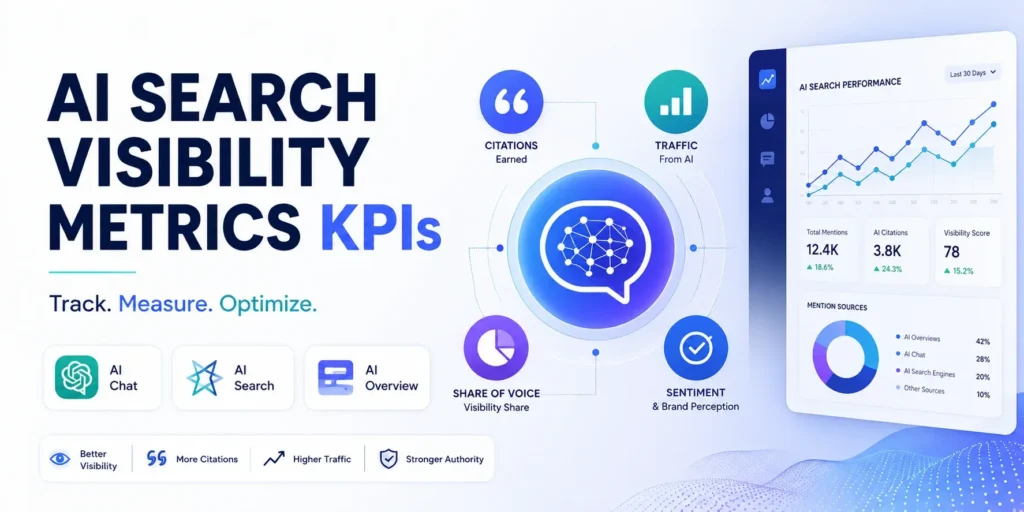
AI search visibility metrics KPIs measure how often, how accurately, and how favorably a brand appears in answers generated by tools like Google AI Overviews, ChatGPT, Perplexity, and Gemini. The core KPIs are citation frequency, AI referral traffic, share of voice, mention sentiment and accuracy, and content citability score. Unlike traditional SEO, these metrics track presence inside an AI-generated answer rather than a ranked link on a results page.
Search marketers spent over a decade optimizing for one thing: a blue link on a results page. That single-minded focus made sense when ten links and a scroll bar were the entire game. But a growing share of queries now never produce a results page at all — they produce an answer, written by a model, with your brand either quoted inside it or invisible to it entirely.
This shift didn’t kill measurement. It just made the old scoreboard incomplete. Rank tracking still tells you something, but it can no longer tell you whether Perplexity mentioned your product in its answer, whether ChatGPT recommended a competitor instead, or whether Google’s AI Overview pulled a stat from your page and gave you no click for it. That’s the gap this guide is built to close.
Key Insights
- Traditional rank tracking and AI visibility tracking answer different questions and need to run side by side, not one replacing the other.
- Citation frequency and referral traffic are the two most reliably measurable AI visibility KPIs today; sentiment and “share of voice” metrics are directionally useful but still maturing.
- Content structured for direct extraction (clear definitions, lists, tables) is cited more often than narrative-style content — this is measurable and testable.
- Most teams under-invest in GA4 segmentation, meaning they’re already receiving AI referral traffic without knowing it.
What Are AI Search Visibility Metrics KPIs?
AI search visibility metrics are quantitative indicators of how a brand, product, or piece of content appears within AI-generated answers — as opposed to how it ranks on a traditional search results page. They exist because generative answer engines don’t show a list of links; they synthesize one response, and a brand either shows up inside that synthesis or it doesn’t.
This discipline is often called Generative Engine Optimization (GEO) or Answer Engine Optimization (AEO), and its KPIs sit alongside — not instead of — classic SEO metrics like organic rankings, impressions, and click-through rate.
Traditional SEO KPIs vs. AI Search KPIs
| Traditional SEO KPI | AI Search Equivalent | What It Measures |
|---|---|---|
| Keyword ranking position | Citation frequency | How often you’re referenced in AI answers for a topic |
| Organic click-through rate | AI referral traffic | Visits originating from AI platforms (chatgpt.com, perplexity.ai, gemini) |
| Share of search (SOV) | AI share of voice | How often you appear vs. competitors across a set of prompts |
| Backlink authority | Citation quality/context | Whether you’re cited as the primary source or a passing mention |
| SERP feature presence | Answer inclusion rate | Whether your content is the basis for the direct answer given |
| Sentiment in reviews | Mention sentiment/accuracy | Whether the AI describes you favorably and correctly |
Full Explanation: The Core KPIs
1. Citation Frequency
How often your brand, product, or content is referenced when a model answers questions in your topic area. Measured by running a consistent set of representative prompts across ChatGPT, Perplexity, Gemini, and Google AI Overviews on a recurring schedule, then logging whether and how you’re mentioned.
2. AI Referral Traffic
Sessions arriving at your site from AI platforms. In GA4, this requires isolating referral sources such as chatgpt.com, perplexity.ai, gemini.google.com, and copilot.microsoft.com — most GA4 setups lump these under “referral” or “unassigned” by default, which is why this traffic is frequently invisible unless segmented deliberately.
3. AI Share of Voice
The proportion of AI answers in your category that mention you versus competitors, across a fixed prompt set tracked over time. This is a comparative, competitive metric rather than an absolute one.
4. Mention Sentiment and Accuracy
Whether the AI describes your brand favorably, neutrally, or negatively — and whether the description is factually correct. Inaccurate mentions are common and worth tracking separately from simple presence/absence.
5. Content Citability Score
An internal, qualitative-to-quantitative score reflecting how “extractable” a page is: does it contain clear definitions, direct answers, lists, and tables that a model can lift cleanly? Pages with these structural traits are cited measurably more often in early GEO research.
Real-World Use Cases
- SaaS company: Tracks citation frequency for “best [category] software” prompts monthly to see if AI Overviews recommend them alongside known competitors.
- Publisher: Segments GA4 to discover Perplexity is now a top-5 traffic source for a specific evergreen guide, and doubles down on that content format.
- E-commerce brand: Monitors mention sentiment after a product recall to check whether AI answers still describe them accurately.
Expert Opinion / Analysis
Rank position is a proxy for potential visibility — it doesn’t confirm anyone saw or acted on it. AI citation is closer to actual visibility because it reflects an answer that was already delivered to the user. That distinction matters for how these two metric sets should be interpreted: rankings estimate opportunity, citations report outcomes.
Market / Industry Impact
Zero-click behavior was already rising before generative answers existed; AI answer engines accelerate it further by resolving the query inside the answer itself. Brands relying solely on click-based reporting risk under-reporting their real visibility and, in board-level reporting, appearing to be losing ground when they’re actually holding a stable or growing footprint inside AI answers.
Pros & Cons of Current AI Visibility Measurement
Pros:
- Reveals visibility invisible to traditional rank trackers
- Referral traffic segmentation is fully within existing GA4/GSC capability today
- Early-mover advantage for brands who start tracking now
Cons:
- No standardized third-party benchmark yet (unlike Domain Authority-style scores)
- Manual prompt-testing is time-consuming and not perfectly repeatable, since AI answers vary run to run
- Sentiment/accuracy tracking still requires human review at scale
Key Takeaways
- Track citation frequency and AI referral traffic first — they’re the most measurable today.
- Segment GA4 for AI platform referrals before assuming you have none.
- Structure content for extractability: definitions, lists, and tables are cited more often.
- Treat AI share of voice and sentiment as directional, not precise, until tooling matures.
- Report AI visibility alongside, not instead of, traditional SEO KPIs.
Common Mistakes
- Assuming zero AI referral traffic just because it isn’t broken out in default GA4 reports
- Testing a single prompt once and treating the result as a stable benchmark
- Ignoring citation accuracy, only tracking citation presence
- Copying competitor content structure instead of building original, clearly-structured explanations
- Reporting AI visibility metrics without noting how immature current measurement methods are
Best Practices
- Build a fixed, repeatable set of 15–30 representative prompts per topic cluster and re-run them on a consistent schedule
- Set up a GA4 custom channel grouping to isolate known AI referral domains
- Structure key pages with a “quick answer” block near the top, formatted as direct, quotable prose
- Use schema markup (Article, FAQ, HowTo) to support machine readability
- Log both presence and sentiment/accuracy for every tracked mention, not just presence
FAQs
What is the most important AI search visibility metric to start with?
AI referral traffic, since it can be measured immediately in GA4 with a custom channel grouping and requires no manual prompt testing.
Can I track AI search visibility with existing SEO tools?
Partially. Google Search Console and GA4 cover referral traffic, but citation frequency and sentiment currently require manual or semi-automated prompt testing, as dedicated third-party tools are still emerging.
Do AI Overviews reduce organic clicks?
Evidence points toward reduced click-through for queries where an AI Overview fully answers the question on the page, though the exact percentage varies significantly by query type and industry.
Is Generative Engine Optimization (GEO) different from SEO?
GEO focuses on being cited inside generated answers, while SEO focuses on ranking a page; the two overlap heavily in fundamentals like E-E-A-T, content clarity, and structured data.
Conclusion
AI visibility metrics don’t replace your existing SEO dashboard — they fill in what it can no longer see. The brands that start tracking citation frequency, AI referral traffic, and content citability now will have a real trend line by the time this becomes standard reporting practice. The ones that wait for a perfect, standardized tool will be measuring from zero after competitors have a year of data.