Quick Answer
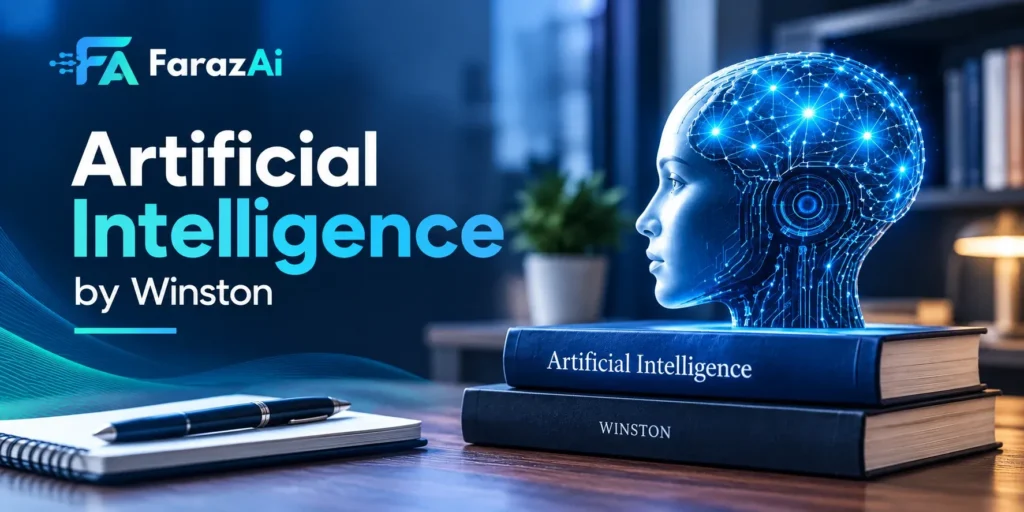
Artificial Intelligence by Winston is a university-level AI textbook written by Patrick Henry Winston, first published in 1977 and revised twice in 1984 and 1992 for a total of three editions. It served as the primary textbook for MIT’s course 6.034 for many years and covers search, knowledge representation, rule-based reasoning, and, from the third edition onward, learning and neural networks. It’s no longer the standard classroom text (that role has largely gone to Russell & Norvig’s Artificial Intelligence: A Modern Approach), but it remains a respected historical and foundational read.
Introduction
Search for “artificial intelligence by Winston” and you’ll mostly find bare bibliographic listings an ISBN, a publisher, a page count. What you won’t easily find is a real explanation of what the book actually is, why it mattered, and whether it’s worth your time today. That’s the gap this guide fills.
Patrick Henry Winston’s Artificial Intelligence isn’t just another old computer science book gathering dust in a library basement. For nearly two decades, it was the text that introduced MIT undergraduates to the field shaping how a generation of engineers, researchers, and computer scientists first learned to think about machine reasoning, search, and learning. Understanding this book means understanding a formative chapter of AI education itself, from before “artificial intelligence” was a term used in product marketing and investor decks.
This guide covers everything: who wrote it, what’s inside each edition, how it was used at MIT, how critics received it, how it stacks up against modern AI texts, and whether picking it up today is a good use of your time.
Who Is Patrick Henry Winston?
Patrick Henry Winston was an American computer scientist and professor of Artificial Intelligence at the Massachusetts Institute of Technology, where he earned his PhD in 1970 under Marvin Minsky one of AI’s founding figures with a thesis focused on the difficulty of machine learning. That pairing matters: Winston wasn’t an outside observer writing about AI secondhand. He trained directly under one of the field’s originators, then spent his career building on that foundation as both a researcher and a teacher.
He went on to direct MIT’s Artificial Intelligence Laboratory (the predecessor to today’s CSAIL) for over two decades and taught the university’s flagship AI course, 6.034, for years. That dual role active researcher and long-running classroom instructor is exactly why the book reads the way it does: less like a dry academic reference and more like carefully refined lecture notes, shaped by real-time feedback from thousands of students over multiple decades.
Beyond the AI textbook itself, Winston also authored companion works on programming languages, including books on Lisp, C++, and Java, and co-wrote a companion LISP text with Berthold Horn that paired directly with the AI book’s second edition.
What Artificial Intelligence by Winston Actually Covers
At its core, the book is designed to explain how computers reason and perceive, and to introduce AI as both a branch of engineering and a science, approached from a computational perspective. It works through ideas for representing knowledge, using that knowledge to solve problems, and assembling those pieces into working systems.
Crucially, the book wasn’t written narrowly for computer science majors. It was aimed at engineers, psychologists, biologists, linguists, and philosophers alike a reflection of just how interdisciplinary early AI research genuinely was. Long before AI became a purely computational specialty, it was understood as a lens for studying intelligence itself, wherever that intelligence showed up: in machines, animals, or the human mind.
Topic-wise, the book covers a broad sweep of classical AI issues, including search strategies, alpha-beta pruning (the algorithm behind early game-playing programs), rule-based reasoning, and depending on the edition increasingly sophisticated treatments of learning.
Edition-by-Edition Breakdown
Artificial Intelligence by Winston wasn’t a static text. It went through three editions across 15 years, and each revision tracked a genuine shift in what the AI field considered important at the time.
| Edition | Year | Key Changes | Notable Additions |
| 1st Edition | 1977 | Original release | Included a dedicated section on Lisp programming |
| 2nd Edition | 1984 | Restructured | Removed the Lisp section; added new chapters on logic and learning; implementation detail moved into the companion LISP book (Winston & Horn) |
| 3rd Edition | 1992 | Major revision | Added a full section on learning, including neural networks; updated to reflect major gains in computer performance and to address AI “at scale” |
This evolution is worth sitting with for a moment. The first edition treated AI almost as an extension of programming practice you learned AI concepts by learning to express them in Lisp. By the second edition, Winston had pulled that implementation detail out entirely, signaling that AI had matured into a field with its own theoretical core, separate from any one programming language. By the third edition, neural networks barely a footnote in earlier editions earned a dedicated treatment, foreshadowing (without fully anticipating) the data-driven turn AI would eventually take.
How the Book Was Used at MIT’s Course 6.034
The book’s most concrete legacy is its role as the official textbook for MIT’s course 6.034, Artificial Intelligence, for many years. That course taught by Winston himself for the bulk of its run introduced students to knowledge representation, problem-solving techniques, and learning methods, with the stated goal of leaving students able to design intelligent systems and understand how search, vision, and language relate to modeling human intelligence computationally.
If you want to experience the book’s ideas the way MIT students originally did, the Fall 2010 recording of 6.034 is freely available through MIT OpenCourseWare, including full lecture videos, problem-solving sessions, and downloadable course materials. Watching even one lecture makes the connection between the book and the course obvious Winston’s teaching style, with its emphasis on clear, procedural explanation, is baked directly into how the book itself is written.
The course structure typically moved through a recognizable arc: starting with reasoning and goal trees, moving into search strategies (depth-first, hill climbing, branch and bound, minimax, alpha-beta), then into constraint-based reasoning for vision and interpretation, and finally into a substantial block on learning nearest neighbors, identification trees, neural networks, genetic algorithms, and support vector machines. That final learning-heavy stretch reflects the third edition’s expanded scope directly.
Critical Reception and Academic Reviews
The book was well regarded within academic circles, though reviewers noted a real shift in its ambitions as it moved through editions. A reviewer for Cambridge University Press found the 1984 (second) edition complete and well suited for classroom use, and specifically called out the value of pairing it with the companion LISP text for hands-on implementation practice.
A separate review from the Association for Computing Machinery (ACM), assessing both the second and third editions, offered a more nuanced take. That review suggested Winston had, over successive editions, leaned into making the book more of a general survey better suited to readers working in AI-adjacent fields than to those wanting a narrowly focused, hands-on programming text. In effect, the reviewer felt Winston had chosen the path of popularizing AI for a broader audience rather than keeping it a tight technical manual. That same review praised the book’s distinctive “procedural English” style: algorithms and programs described in a half-English, half-program format that made dense technical ideas easier to follow without requiring readers to trace actual code line by line.
International Reach and Historical Significance
The book’s influence extended well beyond MIT and the United States. It was among the first Western AI textbooks translated into Chinese and published in China during the early 1980s a notable milestone given how early it came in AI’s development as a global academic discipline. For researchers and students in China encountering the field for the first time through this translation, Winston’s book effectively served as one of their earliest formal introductions to AI as a subject of serious study.
That translation history is a useful reminder of just how central this particular text was to AI’s early institutional spread. Long before online courses, open datasets, and global research collaboration made AI knowledge freely and instantly available, a handful of physical textbooks like this one did the heavy lifting of carrying ideas across borders.
Artificial Intelligence by Winston vs. Modern AI Textbooks
If you’re deciding whether to actually use this book today, it helps to compare it directly against the text that effectively became its successor as the default university standard: Stuart Russell and Peter Norvig’s Artificial Intelligence: A Modern Approach (AIMA), first published in 1995 and still updated in newer editions.
| Artificial Intelligence by Winston (1992, 3rd ed.) | Russell & Norvig’s AIMA | |
| First published | 1977 | 1995 |
| Home institution | MIT | UC Berkeley |
| Modern ML coverage | Limited early neural network coverage only | Extensive, continuously updated |
| Current classroom use | Mostly historical/legacy today | Still a leading standard in many programs |
| Writing style | Procedural English, lecture-note style | Comprehensive academic reference style |
| Best suited for | Understanding AI’s classical foundations and history | Learning current AI methods and techniques |
Winston’s book predates the deep learning era, transformer architectures, and the large-scale statistical and probabilistic methods that define modern AI research and products. That’s expected it reflects exactly when it was written but it does mean it isn’t a substitute for a current AI course if your goal is learning contemporary techniques.
Is Artificial Intelligence by Winston Still Worth Reading?
For most people learning AI from scratch today, this isn’t the book to start with. But as supplementary or historical reading, it holds up surprisingly well, for a few specific reasons:
- Its explanations of classical AI concepts are unusually clear. Search, knowledge representation, and rule-based reasoning are explained with a level of pedagogical care that’s hard to find in more modern, denser references.
- It offers real historical context. Reading it gives you a genuine sense of how the field understood “intelligence” before deep learning reframed the conversation around data and scale.
- The “procedural English” teaching method is still instructive. Even outside AI, Winston’s approach to describing algorithms in accessible, half-narrative form is a technique worth studying if you ever need to explain technical ideas to a mixed audience.
Its limits are just as clear. It won’t teach you transformers, large language models, reinforcement learning at scale, or anything from the last three decades of AI progress because none of that existed yet when it was written.
Common Mistakes People Make Researching This Book
- Assuming it’s a current, actively-used AI textbook. It’s a historical and foundational text focused on classical, symbolic AI not a guide to modern machine learning.
- Confusing it with Russell & Norvig’s AIMA. These are two different books by different authors; AIMA is the more commonly assigned text in current courses.
- Ignoring the differences between editions. The heavily Lisp-focused first edition reads very differently from the broader-survey third edition knowing which edition you’re looking at matters.
- Expecting hands-on, runnable code. Later editions moved away from concrete implementation details in favor of conceptual explanation.
Best Practices for Using This Book Today
- Treat it as historical or foundational reading, not a primary current-day AI course text.
- Pair it with MIT’s free 6.034 lecture videos on OpenCourseWare to get the full original classroom experience.
- Read it alongside a modern text like AIMA if your actual goal is a complete, up-to-date picture of the field.
- Focus specifically on the search and knowledge-representation chapters, since those classical techniques remain genuinely foundational even in modern AI systems.
- Check which edition you’re using before drawing conclusions about what it does or doesn’t cover the differences between 1977, 1984, and 1992 are substantial.
Key Takeaways
- Artificial Intelligence by Winston was MIT’s primary 6.034 course textbook across three editions: 1977, 1984, and 1992.
- Each edition tracked genuine shifts in the field from Lisp-centered programming, to formal logic and learning, to early neural networks.
- The book was well reviewed academically and was among the first Western AI texts translated into Chinese.
- It has since been succeeded by newer standards, most notably Russell & Norvig’s AIMA, for current AI education.
- It remains valuable today as historical and foundational reading not as a primary text for learning modern AI.
Conclusion
Artificial Intelligence by Winston isn’t a book you should turn to if you want to learn how today’s AI systems actually work that job belongs to newer texts built around deep learning, large language models, and modern probabilistic methods. But as a record of how one of the field’s most respected teachers explained intelligence itself, at a formative moment before any of that existed, it still earns real value. For anyone serious about understanding where AI’s foundational ideas came from or simply looking for a masterclass in explaining complex technical ideas with clarity Winston’s book remains worth the time.
FAQs
Who wrote Artificial Intelligence by Winston?
Patrick Henry Winston, a longtime MIT professor and former director of the MIT Artificial Intelligence Laboratory, wrote and revised the book across three editions.
How many editions of Artificial Intelligence by Winston were published?
Three editions were published: 1977, 1984, and 1992.
What MIT course used Artificial Intelligence by Winston as its textbook?
MIT’s course 6.034, Artificial Intelligence, used it as the primary textbook for many years, taught by Winston himself.
Does Artificial Intelligence by Winston cover neural networks?
Only the third edition, published in 1992, added a dedicated section on learning that included neural networks; earlier editions predate that coverage.
Is Artificial Intelligence by Winston still used in university courses today?
Rarely as a primary text — most current courses have shifted to newer books such as Artificial Intelligence: A Modern Approach, though Winston’s book is still cited for classical AI concepts.
Where can I access related course materials for free?
MIT OpenCourseWare hosts the Fall 2010 recording of Winston’s 6.034 lectures, along with downloadable course resources, at no cost.
Is Artificial Intelligence by Winston a good first AI book for beginners?
It can work as a conceptual introduction to classical AI reasoning and search, but it should be paired with a modern text if your goal is to understand current AI techniques like deep learning.