BrandRank.ai Normalization Transformation Rules: A Complete Guide to Improving AI Visibility
Quick Answer
BrandRank.ai Normalization Transformation Rules are a set of practices that standardize your brand information across websites, directories, structured data, and digital platforms. Consistent data helps AI systems like ChatGPT, Gemini, Claude, and Perplexity recognize your brand correctly, increasing the chances of accurate citations and better AI visibility.
Key Facts
| Feature | Why It Matters |
| Brand Name Consistency | Prevents AI from treating the same brand as multiple entities |
| Structured Data | Gives AI clear context about your business |
| Entity Optimization | Strengthens Knowledge Graph connections |
| AI Citations | Improves the chances of being referenced in AI-generated answers |
| Content Consistency | Builds trust with both search engines and AI models |
Why Brand Normalization Matters in the AI Search Era
Search behavior is changing rapidly. Instead of scrolling through ten blue links, users increasingly ask AI assistants direct questions and expect immediate answers.
For example:
- What is the best AI SEO tool?
- Which CRM is best for startups?
- What is the safest cloud storage platform?
Instead of displaying websites, AI models generate a summarized answer by combining information from trusted sources.
This changes how brands gain visibility online.
Traditional SEO focuses on ranking pages in search engines. AI search focuses on selecting the most trustworthy information to include in generated answers. If your brand data is inconsistent, AI systems may misunderstand your business or ignore it entirely.
This is where BrandRank.ai Normalization Transformation Rules become important.
What Are BrandRank.ai Normalization Transformation Rules?
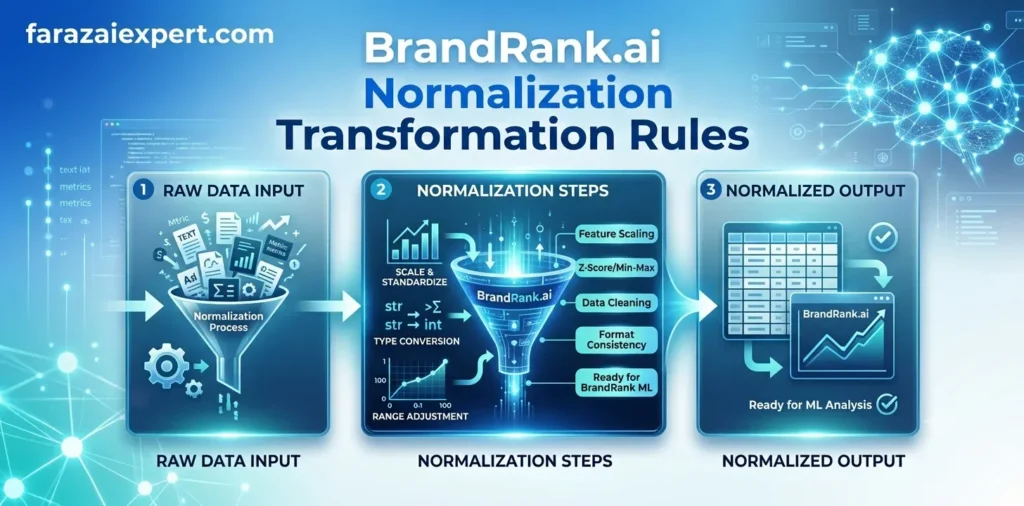
These transformation rules are designed to make brand information clear, consistent, and machine-readable.
Rather than allowing different versions of your business to appear across the web, normalization creates one authoritative representation that AI systems can confidently understand.
Imagine your business appears online like this:
- TechNova
- Tech Nova
- TechNova Solutions
- TechNova Pvt Ltd
A human immediately recognizes these as the same company.
An AI model may not.
Normalization transforms every variation into a single, standardized identity.
The result is stronger entity recognition and greater confidence in AI-generated responses.
How AI Systems Understand Your Brand
Modern AI models don’t simply read web pages. They identify relationships between entities and evaluate how consistently those entities appear across multiple sources.
These sources may include:
- Official websites
- Business directories
- Review platforms
- News publications
- Social profiles
- Product pages
- Knowledge databases
- Structured data
The more consistent these signals are, the easier it becomes for AI to understand your brand.
If different websites publish conflicting information, AI confidence decreases.
That can reduce your visibility in AI-generated answers.
Understanding Data Normalization
Data normalization simply means organizing information into a consistent format.
Its purpose is to remove confusion.
For businesses, normalization usually involves standardizing:
- Brand names
- Product names
- Categories
- Addresses
- Phone numbers
- Dates
- URLs
- Metadata
- Structured data
Consider this simple example.
| Before Normalization | After Normalization |
| Brand Rank AI | BrandRank.ai |
| BrandRank AI | BrandRank.ai |
| BrandRankAI | BrandRank.ai |
| Brand Rank.ai | BrandRank.ai |
Although every variation refers to the same company, AI systems may interpret them differently unless they are normalized.
Why Consistency Improves AI Visibility
AI models evaluate trust before they generate answers.
When they repeatedly encounter the same information from multiple reliable sources, confidence increases.
Consistency helps AI answer important questions such as:
- Is this the official business name?
- Is this the correct website?
- Which product belongs to this company?
- Which information is the most current?
- Which source is the most reliable?
The stronger the answers to these questions, the greater the likelihood that AI systems will recommend or cite your brand.
The Relationship Between Normalization and Entity SEO
Entity SEO focuses on optimizing people, organizations, products, and places rather than only targeting keywords.
Instead of simply optimizing for phrases like “best AI software,” businesses now need AI systems to understand:
- who they are,
- what they offer,
- where they operate,
- and how they relate to other entities.
For example:
| Entity | Relationship |
| BrandRank.ai | AI Visibility Platform |
| AI Visibility | Answer Engine Optimization |
| Structured Data | Entity Recognition |
| Knowledge Graph | AI Understanding |
The clearer these relationships become, the easier it is for AI models to recommend your brand.
Core Components of Brand Normalization
Successful normalization combines several technical and content-related practices.
1. Brand Name Standardization
Your business should use one official name everywhere.
That includes:
- Website
- Social media
- Business listings
- Press releases
- Product pages
- Structured data
Using multiple spellings creates unnecessary confusion.
2. Product Name Consistency
Products should also follow one naming convention.
Instead of using:
- AI Rank Tool
- AI Ranking Tool
- AI Rank Tracker
Choose one official product name and use it consistently across every platform.
3. Category Standardization
Businesses often describe themselves differently on different websites.
For example:
- AI Tool
- AI Platform
- SaaS
- Machine Learning Software
Choose a primary category and maintain consistency.
This helps AI understand exactly where your business belongs.
4. Structured Data Optimization
Structured data gives AI explicit information instead of forcing it to guess.
Important schema types include:
- Organization Schema
- Product Schema
- Article Schema
- FAQ Schema
- Review Schema
These schemas provide additional context that improves machine understanding.
How Normalization Supports Answer Engine Optimization (AEO)
Answer Engine Optimization focuses on helping AI assistants choose your content when generating answers.
Normalization directly supports AEO because it removes ambiguity.
Instead of asking:
“Are these four different companies?”
AI confidently understands:
“These references all belong to one trusted brand.”
This increases:
- AI citations
- Brand authority
- Knowledge Graph accuracy
- Entity confidence
- Answer visibility
As AI search continues to grow, normalization becomes one of the strongest foundations of AEO.
Practical Examples of Normalization Rules
The following examples demonstrate how small improvements can significantly improve AI understanding.
| Data Type | Before | After |
| Company Name | TechNova Pvt Ltd, Tech Nova | TechNova |
| Product | AI Writer Pro, AI-Writer Pro | AI Writer Pro |
| Date | 01/12/26, Jan 12 2026 | 2026-01-12 |
| Phone | (123)4567890, +1-123-456-7890 | +1 123 456 7890 |
| Country | USA, US, United States | United States |
Even simple changes like these improve consistency across digital platforms.
Common Problems Caused by Inconsistent Data
Poor normalization often creates hidden issues that affect both SEO and AI visibility.
Some common problems include:
- Duplicate business listings
- Different company names across websites
- Outdated addresses
- Multiple phone numbers
- Broken structured data
- Inconsistent product names
- Mixed category labels
- Conflicting publication dates
Each inconsistency reduces AI confidence and makes it harder for answer engines to recommend your brand.
How AI Citations Improve Brand Visibility
One of the biggest changes in digital marketing is the growing importance of AI citations. Instead of only ranking web pages, AI assistants now reference brands they consider trustworthy when generating answers.
If someone asks:
- What is the best AI visibility platform?
- Which tools help businesses improve AI search performance?
The AI may mention only a handful of brands. Whether your business appears in those responses depends largely on how confidently the AI understands your brand.
Normalization helps increase that confidence by ensuring your information is consistent across every digital touchpoint.
Factors That Increase AI Citation Potential
- Consistent brand name
- Accurate business information
- High-quality content
- Structured data
- Trusted backlinks
- Strong entity relationships
- Updated company information
The clearer your digital footprint, the easier it becomes for AI systems to reference your business.
BrandRank.ai Normalization and Knowledge Graphs
Knowledge Graphs connect related entities such as businesses, products, services, people, and locations.
Instead of seeing isolated pieces of information, AI builds a network of relationships.
For example:
| Entity | Connected To |
| TechNova | AI Software |
| AI Software | Marketing Automation |
| Marketing Automation | Small Businesses |
| TechNova | Customer Support Platform |
When these relationships are clear, AI can answer questions more accurately and confidently.
Normalization ensures that all of these relationships point to the same official entity rather than multiple fragmented versions of your brand.
Step-by-Step Guide to Implement Brand Normalization
Improving AI visibility doesn’t happen overnight. A structured approach delivers the best long-term results.
Step 1: Audit Your Existing Brand Data
Start by reviewing every place where your business appears online.
Check your:
- Website
- Google Business Profile
- Social media accounts
- Business directories
- Product pages
- Press releases
- Review websites
Look for inconsistent names, outdated information, duplicate listings, or incorrect URLs.
Step 2: Create Official Brand Standards
Document your official business information.
Include:
- Brand name
- Business description
- Logo
- Website URL
- Contact details
- Product names
- Categories
- Social media profiles
Every team member should use these standards when publishing content.
Step 3: Standardize Structured Data
Implement structured data across your website using relevant Schema types.
Recommended schemas include:
- Organization
- Product
- Article
- FAQ
- Breadcrumb
Structured data helps AI understand exactly what each page represents.
Step 4: Maintain Consistent Content
Publish content using the same terminology throughout your website.
For example, if your primary service is AI Visibility Monitoring, avoid randomly switching to:
- AI Monitoring Platform
- AI Ranking Tool
- AI Visibility Tracker
Unless they represent different products.
Consistency improves entity recognition.
Step 5: Review and Update Regularly
AI search changes continuously.
Schedule monthly audits to check:
- Broken schema
- Outdated business details
- Duplicate pages
- Incorrect metadata
- New brand mentions
- AI-generated citations
Regular maintenance keeps your information accurate.
AI Visibility Checklist
Use this checklist to evaluate your readiness for AI-powered search.
| Checklist Item | Status |
| One official brand name | ✓ |
| Consistent product names | ✓ |
| Structured data implemented | ✓ |
| Canonical URLs | ✓ |
| Updated contact details | ✓ |
| Clear business categories | ✓ |
| Author pages | ✓ |
| FAQ content | ✓ |
| Internal linking | ✓ |
| Fresh content updates | ✓ |
The more items you complete, the stronger your AI visibility foundation becomes.
Common Mistakes Businesses Make
Many businesses unknowingly reduce their AI visibility through avoidable mistakes.
Using Different Brand Names
Publishing multiple versions of your company name weakens entity recognition.
Ignoring Structured Data
Without schema markup, AI has to infer information rather than reading it directly.
Publishing Duplicate Content
Duplicate pages create confusion and split authority.
Keeping Outdated Information
Old addresses, phone numbers, pricing, or leadership details reduce trust.
Inconsistent Product Naming
Changing product names across different platforms makes it difficult for AI to connect all related information.
Expert Tips for Better AI Visibility
If your goal is to increase AI mentions and improve Answer Engine Optimization, follow these best practices.
- Maintain a single official brand identity.
- Publish original, research-based content.
- Use descriptive headings and logical page structures.
- Update articles regularly to keep information fresh.
- Build relationships with authoritative industry websites.
- Implement complete schema markup.
- Monitor how your brand appears in AI-generated answers.
- Focus on entity optimization instead of keyword stuffing.
These practices help both traditional search engines and modern AI systems understand your content more effectively.
Brand Normalization vs Traditional SEO
| Traditional SEO | Brand Normalization |
| Focuses on keywords | Focuses on entities |
| Improves rankings | Improves AI understanding |
| Optimizes pages | Optimizes brand data |
| Targets search engines | Targets AI answer engines |
| Builds backlinks | Builds entity trust |
The two approaches work together rather than replacing each other.
Final Thoughts
As AI-powered search becomes more common, businesses must think beyond traditional SEO. Visibility is no longer determined only by rankings—it also depends on whether AI systems understand and trust your brand.
BrandRank.ai Normalization Transformation Rules provide a practical framework for making business information consistent, machine-readable, and easier for AI to interpret. By standardizing brand names, product details, categories, structured data, and other key elements, organizations can improve entity recognition and strengthen their presence across AI-driven platforms.
The brands that succeed in the future will not simply publish more content. They will publish clearer, more accurate, and consistently structured information that AI systems can trust.
Investing in normalization today helps build stronger AI visibility, better brand authority, and a competitive advantage as Answer Engine Optimization continues to evolve.
Frequently Asked Questions
What are BrandRank.ai Normalization Transformation Rules?
They are methods used to standardize brand-related information so AI systems can recognize a business consistently across websites, directories, and AI search platforms.
Why is normalization important for AI visibility?
Consistent data increases AI confidence, improves entity recognition, and raises the chances of being cited in AI-generated answers.
Does normalization improve SEO?
Yes. Better data consistency supports structured data, improves crawlability, strengthens entity SEO, and contributes to both traditional SEO and Answer Engine Optimization.
Is Answer Engine Optimization replacing SEO?
No. SEO helps users find your website through search engines, while AEO helps AI assistants understand and recommend your content. Businesses should optimize for both.
Can small businesses benefit from normalization?
Absolutely. A well-structured and consistent online presence allows smaller businesses to compete with larger brands in AI-generated search results.