
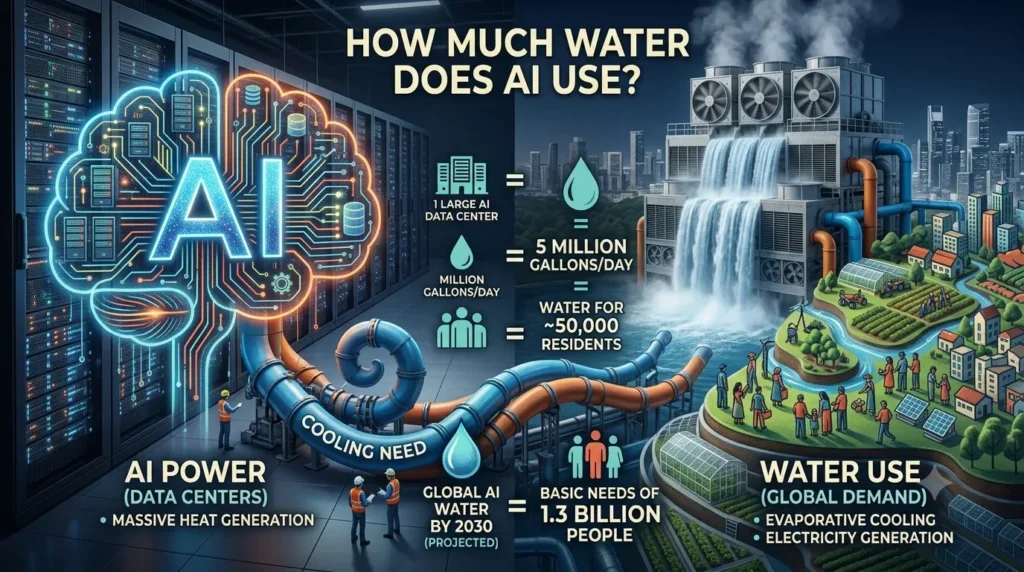
How Much Water Does AI Use? Understanding AI’s Growing Water Footprint
Artificial intelligence is changing how people work, learn, search, and create content. Every day, millions of users ask AI assistants questions, generate images, write code, and analyze documents. Behind every AI response, however, is a massive network of data centers running thousands of powerful processors that consume both electricity and water.
As AI adoption accelerates worldwide, researchers, environmental organizations, and technology companies are paying closer attention to AI’s environmental footprint. While most people associate AI with high electricity consumption, water usage is becoming an equally important issue because data centers require cooling systems to prevent servers from overheating.
If you’ve ever wondered “How Much Water Does AI Use?”, the answer depends on several factors, including the size of the AI model, where the data center is located, the local climate, and the cooling technology used. Some AI requests use only a tiny amount of water indirectly, while training advanced AI models can require millions of liters over weeks or months.
This guide explains where AI’s water consumption comes from, how much water large AI systems may use, why cooling is essential, and what technology companies are doing to reduce their environmental impact.
Quick Answer
AI uses water primarily to cool the servers inside data centers. A single AI query indirectly consumes only a very small amount of water, but billions of AI interactions combined can require significant amounts of freshwater. Training large AI models may consume millions of liters of water, while the global expansion of AI infrastructure is increasing demand for both electricity and water resources.
Key Facts at a Glance
| Fact | Details |
| Why AI uses water | Cooling servers and supporting electricity generation |
| Largest source of water use | Data center cooling systems |
| Training AI models | Can require millions of liters of water depending on size and location |
| Everyday AI queries | Small individual footprint but large cumulative impact |
| Main challenge | Balancing AI growth with sustainable resource management |
| Industry response | Water-efficient cooling, renewable energy, liquid cooling, recycled water |
Why Does AI Use Water?
Many people imagine AI existing only in the cloud, but every AI model runs on physical hardware located inside large data centers.
These facilities contain thousands of GPUs, CPUs, networking equipment, storage devices, and power systems that generate enormous amounts of heat. Without cooling, temperatures would quickly rise high enough to damage expensive hardware or reduce performance.
Water plays a major role in removing this heat.
AI itself does not consume water directly. Instead, the infrastructure supporting AI requires water to operate safely and efficiently.
The largest sources of AI-related water consumption include:
- Cooling data center servers
- Cooling GPU clusters during AI training
- Electricity generation used to power AI systems
- Climate control inside server facilities
- Manufacturing AI hardware
This means AI’s water footprint includes both direct and indirect water use.
Where Does AI Water Consumption Come From?
AI water use comes from several interconnected processes rather than a single activity.
1. Data Center Cooling
The biggest contributor is cooling.
Modern AI servers contain high-performance GPUs capable of consuming hundreds or even thousands of watts each. Large AI clusters can contain tens of thousands of GPUs working simultaneously.
Cooling systems often rely on:
- Cooling towers
- Evaporative cooling
- Chilled water systems
- Heat exchangers
- Liquid cooling technologies
Many facilities circulate water continuously to remove excess heat before returning cooled water back into the system.
2. Electricity Production
AI requires enormous amounts of electricity.
Power plants that generate electricity—especially thermal and nuclear plants—often use significant quantities of water for cooling.
Even if a data center itself uses very little water, the electricity it consumes may have required substantial water elsewhere in the energy supply chain.
This is called the indirect water footprint.
3. AI Model Training
Training modern foundation models is one of the most resource-intensive computing tasks ever developed.
Training involves:
- Processing trillions of words
- Running billions of calculations every second
- Operating thousands of GPUs continuously
- Running for weeks or months
During this period, cooling systems operate around the clock, increasing water demand.
Larger models generally require:
- More processors
- Longer training periods
- Higher electricity consumption
- Greater cooling requirements
How Much Water Does AI Use in a Prompt?
This is one of the most searched questions online, but the answer is more complicated than many headlines suggest.
A single AI request does not directly consume a glass of water sitting beside a server.
Instead, researchers estimate the water associated with an AI interaction by considering:
- Server cooling
- Electricity generation
- Data center efficiency
- Geographic location
- Weather conditions
- AI workload
Because these factors vary, there is no universal amount of water used per prompt.
What is clear is that the environmental impact becomes much larger when billions of AI requests are processed every day across the world.
Factors That Affect AI Water Usage
Not all AI systems have the same environmental footprint.
Several important factors determine how much water is required.
| Factor | Impact on Water Usage |
| Data center location | Hot climates require more cooling |
| Weather | Higher temperatures increase cooling demand |
| Cooling technology | Advanced systems reduce water use |
| AI model size | Larger models need more computing power |
| Hardware efficiency | New GPUs perform more work per watt |
| Renewable energy | Can lower indirect water consumption |
| Workload intensity | Training consumes more resources than inference |
Is AI Training More Water-Intensive Than Using AI?
Yes.
There is an important difference between:
AI Training
Training happens once (or occasionally).
It requires:
- Massive computing clusters
- Continuous GPU operation
- Weeks or months of processing
- Extensive cooling
This phase generally has the highest water footprint.
AI Inference
Inference refers to everyday use after the model has already been trained.
Examples include:
- Asking an AI chatbot a question
- Creating an image
- Summarizing a document
- Translating text
- Writing code
Each individual request requires relatively little computing power compared with training, but billions of daily requests create a significant cumulative environmental impact.
Why AI Water Use Is Becoming a Global Concern
The rapid growth of generative AI has increased demand for new data centers worldwide.
Technology companies are investing billions of dollars in AI infrastructure, with many facilities being built in regions already facing water stress.
This creates several challenges:
- Competition for freshwater resources
- Increased pressure during droughts
- Higher electricity demand
- Greater carbon emissions if powered by fossil fuels
- Sustainability concerns for local communities
Governments, researchers, and environmental organizations are increasingly encouraging companies to improve transparency around both energy and water consumption.
How Much Water Does ChatGPT Use?
One of the biggest questions people ask is: “How much water does ChatGPT use per prompt?”
The truth is that there isn’t a fixed answer.
ChatGPT runs on large AI infrastructure spread across multiple data centers. The amount of water associated with a single prompt depends on several variables, including:
- The data center processing your request
- The cooling system used
- The outside temperature
- The complexity of your prompt
- The hardware running the model
- The local electricity grid
A widely discussed academic estimate suggested that generating a medium-length AI response could be associated with approximately 500 milliliters (about one standard water bottle) of water under specific assumptions. However, this estimate should not be interpreted as a universal amount for every ChatGPT prompt. It was based on particular workloads, locations, and cooling conditions rather than every interaction.
The key takeaway is that individual prompts have a relatively small indirect water footprint, but the cumulative effect of hundreds of millions or billions of AI interactions each day can become significant.
AI vs Traditional Internet Services
Many people assume AI uses about the same resources as a normal web search.
In reality, modern generative AI typically requires much more computation.
| Activity | Computing Demand | Relative Water Use |
| Reading a webpage | Very Low | Very Low |
| Sending an email | Low | Low |
| Google search | Low | Low |
| Streaming a video | Moderate | Moderate |
| AI chatbot conversation | High | Higher |
| AI image generation | Very High | Higher |
| AI model training | Extremely High | Highest |
The more complex the AI task, the more computing hardware is needed, increasing cooling requirements.
Which Industries Are Driving AI Water Consumption?
AI is expanding across nearly every industry.
The sectors contributing most to AI infrastructure growth include:
- Healthcare
- Financial services
- Software development
- Scientific research
- Autonomous vehicles
- Cloud computing
- Media and entertainment
- Education
- Manufacturing
- Government services
As AI adoption grows, demand for data centers—and the water needed to cool them—also increases.
How Technology Companies Are Reducing AI Water Usage
Major technology companies understand that sustainability is becoming increasingly important.
Many are investing heavily in reducing both water and energy consumption.
Common strategies include:
1. Liquid Cooling
Instead of cooling the entire room, liquid cooling removes heat directly from high-performance processors.
Benefits include:
- Higher efficiency
- Less energy use
- Lower water consumption
- Better cooling performance
2. Closed-Loop Cooling Systems
Rather than continuously consuming fresh water, closed-loop systems recycle the same water multiple times.
Advantages include:
- Reduced freshwater demand
- Lower operating costs
- Better environmental performance
3. Using Reclaimed Water
Some data centers now use treated wastewater instead of drinking water.
This helps preserve freshwater supplies for communities.
4. Smarter AI Hardware
Modern AI chips are becoming significantly more energy efficient.
More efficient processors mean:
- Less heat
- Smaller cooling systems
- Reduced electricity demand
- Lower water consumption
5. Better Data Center Locations
Companies increasingly build data centers where:
- Temperatures are cooler
- Renewable energy is abundant
- Water availability is more sustainable
- Natural cooling can reduce resource use
Challenges of AI Water Consumption
Despite improvements, several challenges remain.
Growing AI Demand
Millions of new users begin using AI every month.
As demand rises, companies continue building larger computing facilities.
Water-Stressed Regions
Some data centers operate in areas already experiencing drought or water shortages.
Balancing technological growth with local water needs is becoming an important planning consideration.
Limited Transparency
Not every company publicly reports:
- Water consumption
- Cooling efficiency
- Local environmental impact
- AI-specific resource usage
Improved reporting can help researchers and policymakers better understand AI’s environmental footprint.
Common Myths About AI Water Usage
| Myth | Reality |
| AI directly drinks water | Water is primarily used to cool the infrastructure supporting AI. |
| Every ChatGPT prompt uses exactly the same amount of water | Water use varies depending on workload, location, hardware, and cooling systems. |
| Water use is the only environmental issue | Electricity, carbon emissions, hardware manufacturing, and electronic waste also matter. |
| AI companies ignore sustainability | Many companies are investing in more efficient cooling, renewable energy, and water conservation. |
| AI will always consume increasing amounts of water | Advances in hardware and cooling technologies can improve efficiency even as AI grows. |
Best Practices for Sustainable AI
While individual users have limited control over data center operations, responsible AI use can still contribute to broader sustainability goals.
Some practical approaches include:
- Use AI when it provides meaningful value.
- Avoid generating unnecessary or repetitive outputs.
- Prefer concise prompts instead of repeated trial-and-error.
- Support organizations that publish sustainability reports.
- Stay informed about developments in green computing.
Pros and Cons of AI’s Water Use
| Pros | Cons |
| Enables powerful AI applications | Requires cooling infrastructure |
| Supports innovation in healthcare, education, and science | Can increase freshwater demand |
| Improving hardware efficiency | Large-scale AI training is resource-intensive |
| New cooling technologies reduce consumption | Some facilities operate in water-stressed regions |
| Sustainability efforts are expanding | Public reporting is still inconsistent |
Expert Perspective
AI’s water consumption should be viewed in context.
The question is not simply “Does AI use water?”—it clearly does through the infrastructure that supports it.
A more useful question is how efficiently AI uses water compared with the value it creates.
As the industry matures, success will depend on balancing innovation with responsible resource management. Continued investment in efficient chips, advanced cooling systems, renewable energy, and transparent reporting will play a critical role in making AI more sustainable.
Key Takeaways
- AI primarily uses water indirectly through data center cooling and electricity generation.
- Training large AI models consumes significantly more resources than answering everyday prompts.
- There is no single amount of water used for every AI interaction.
- Cooling technology, climate, hardware efficiency, and energy sources all influence AI’s water footprint.
- The technology industry is investing in liquid cooling, recycled water, and more efficient infrastructure.
- Sustainable AI will require ongoing innovation in both hardware and data center design.
Conclusion
Artificial intelligence is transforming industries around the world, but its rapid growth also raises important questions about sustainability. Water plays a crucial role in keeping the data centers that power AI running safely and efficiently. While a single AI interaction has a relatively small indirect water footprint, the combined impact of billions of requests and large-scale model training is significant.
Fortunately, the future is not solely about higher resource consumption. More efficient processors, innovative cooling technologies, greater use of recycled water, and transparent sustainability practices are helping reduce AI’s environmental footprint. As AI continues to evolve, responsible infrastructure development will be just as important as advances in the technology itself.
Frequently Asked Questions
Does AI actually use water?
Not directly. Water is mainly used to cool servers and, in some cases, to generate the electricity that powers AI systems.
Why do data centers need water?
Servers produce large amounts of heat. Water-based cooling systems help maintain safe operating temperatures and improve efficiency.
Is AI more water-intensive than a normal Google search?
In general, generative AI tasks require more computing resources than a traditional web search, which can translate to a larger indirect water footprint.
Does every AI prompt use the same amount of water?
No. Water use varies depending on the model, hardware, data center, cooling method, and local environmental conditions.
Can AI become more environmentally friendly?
Yes. Advances such as liquid cooling, energy-efficient hardware, reclaimed water, and renewable energy can reduce AI’s environmental impact.