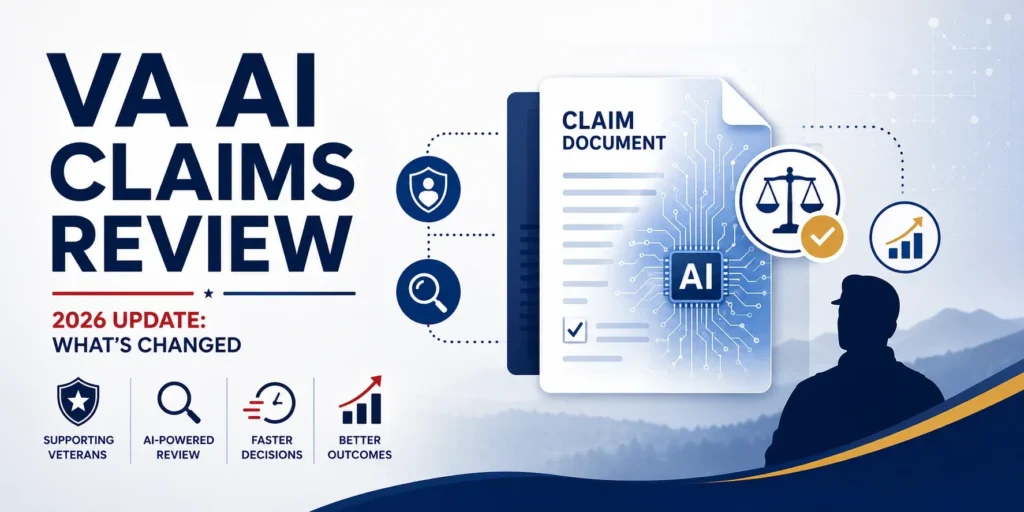
Veterans Affairs AI Claims Review: What’s Actually Happening in 2026
Quick Answer
The Department of Veterans Affairs (VA) is expanding its use of artificial intelligence to process disability claims faster, but a separate plan to use AI to hunt for fraud in more than a million past claims was scrapped in March 2026 after major backlash. Current AI use focuses on speeding up claims processing — automating document intake, prepopulating forms, and routing evidence — while a federal watchdog has warned that unresolved technology and oversight problems could still limit how well this modernization effort works.
Key Insights
- VA’s AI use splits into two very different efforts: forward-looking claims-processing automation (largely uncontroversial) and backward-looking fraud detection on already-approved claims (the part that triggered public backlash).
- In March 2026, the VA canceled a plan to scan 1.2 million finalized disability claims for potential fraud after pressure from veterans’ advocacy groups.
- The VA has digitized more than 1.2 billion veteran claim evidence documents and cut its rating backlog by more than 73% since January 2025.
- A July 2026 GAO report warned that unresolved management, training, and technology weaknesses could complicate VA’s AI modernization plans.
- The debate isn’t really “AI vs. no AI” — it’s about where AI is used, how much human oversight remains, and whether speed is coming at the cost of accuracy.
What Is Veterans Affairs AI Claims Review AI Claims Review, Exactly?
“AI Claims Review” at the VA isn’t one single system — it refers to several distinct efforts under the Veterans Benefits Administration (VBA), each with a different purpose:
- Forward-facing automation — tools that help process new claims faster by digitizing documents, extracting medical evidence, and prepopulating routine paperwork.
- Fraud-detection review — a now-cancelled plan to re-scan over a million previously approved Disability Benefits Questionnaires (DBQs) for signs of fabrication or inconsistency.
- Decision-support tools — systems that assist human raters by organizing evidence, without making final decisions themselves.
Understanding which of these a headline is referring to matters, because the public reaction to each has been very different.
The Fraud-Detection Plan That Sparked Backlash
In early 2026, VA officials announced one of the more controversial uses of AI in the agency’s history: an automated tool designed to re-examine roughly 1.2 million DBQs dating back as far as 15 years, looking for patterns associated with fraud.
VA officials described the tool as capable of quickly reviewing submitted DBQs — the questionnaires used to document medical evidence for disability ratings and monthly compensation. The VA maintained that most veterans had nothing to fear, framing the effort as protecting the integrity of the benefits program, even as the scale of the review — covering more than a million DBQs — raised concern that legitimate claims could get caught in the net.
Veterans service organizations pushed back hard. DAV raised concerns about how the AI tool would affect veterans’ disability compensation and what safeguards existed to protect veterans’ rights, requesting transparency about how the tool was developed, tested, and would be used. Critics also questioned whether the tool would even work as intended, with one retired benefits service officer predicting that while some fraud would be found, many DBQs would be flagged that weren’t actually fraudulent.
The pressure worked. The VA reversed course, abandoning the plan to review a decade’s worth of disability claims after sustained backlash from veterans’ advocacy groups, lawmakers, and legal professionals who warned it could unfairly target disabled veterans. Following the cancellation, the agency shifted this technology’s focus toward new claims only, rather than reopening previously finalized ones.
Notably, this wasn’t an isolated reversal — earlier in 2026, the VA had also halted a separate rule that could have reduced disability ratings based on how well a veteran’s condition responded to medication, following similar pushback. Together, these episodes suggest the VA is actively testing more aggressive automation and enforcement approaches, but backing off quickly when veteran advocacy groups and lawmakers object.
What AI Is Actually Being Used for Right Now
Separate from the fraud-detection controversy, the VA has been steadily expanding AI use in the claims pipeline itself — and this side of the effort has drawn far less controversy.
VA has already been using AI tools to better process benefits claims and plans to lean on these capabilities further to speed up turnaround times, since claims processing can otherwise take weeks or months. Two active use cases stand out:
- Toxic Exposure Risk Activity (TERA) Memo Automation — the PACT Act requires veterans to submit detailed information about toxic exposure, a process that could take 30 to 60 minutes to complete manually; VA now uses machine learning to prepopulate portions of these draft memos automatically.
- Automated Decision Support (ADS) — this system uses machine learning to automate some of the time-consuming, up-front development activities involved in retrieving and organizing evidence, without making decisions about the claims itself.
A VA press official was explicit about the boundary here: the automation streamlines the process but does not make any decisions about veterans’ claims. That distinction — automating preparation versus automating judgment — is central to how the VA has tried to frame its AI strategy to a skeptical audience.
The Numbers Behind the Push
By mid-2026, VA officials were pointing to genuinely large productivity gains tied to this modernization effort. The agency has expanded its use of natural language processing to extract relevant medical evidence from unstructured records and has digitized more than 1.2 billion veteran claim evidence documents. The backlog reduction has been substantial: the rating backlog decreased by more than 73% since January 2025 and has stayed below 75,000 since May 6, 2026.
Volume and accuracy figures tell a similar story. The VA processed more than two million disability benefits claims in fiscal year 2026 as of June 1, with claims-processing accuracy rising to 94.02% — the highest 12-month rate in two years.
The Catch: Workforce Cuts and Oversight Gaps
The productivity numbers come with a significant caveat that dominated a July 2026 congressional hearing. Despite the improved backlog and accuracy metrics, the VA has simultaneously lost more than 1,100 veteran claims examiners in the current fiscal year. That created a visible tension in the hearing room: the administration’s push to accelerate claims processing through AI ran up against concerns from lawmakers that workforce cuts were undermining accuracy and veteran service, even as officials from both sides acknowledged that speed shouldn’t come at the expense of quality or human oversight. One VA official testified directly to this concern, stating plainly that these tools support human decision-making rather than replace it — though critics note that fewer examiners inevitably means more of the workload shifts onto whatever automation is available.
Federal auditors have independently flagged risk here too. A Government Accountability Office report warned that unresolved weaknesses in program management and information technology could complicate VA’s modernization plans, even as the agency works to update the technology used by the Veterans Benefits Administration.
The GAO’s chief scientist testified that VA has faced longstanding challenges in managing programs and IT projects, a concern with real stakes given the scale involved: during fiscal year 2025 alone, the VA distributed more than $195 billion in disability compensation to more than 6.9 million veterans and family members.
Legal Context: Why Review Standards Matter
AI claims review doesn’t happen in a legal vacuum — it operates alongside existing rules about how VA decisions get reviewed. A relevant recent precedent is Bufkin v. Collins, decided by the Supreme Court in March 2025, which held that the Court of Appeals for Veterans Claims must apply clear error review when assessing how the VA applies the “benefit-of-the-doubt rule” in a veteran’s disability claim. That rule — which requires ties to be resolved in the veteran’s favor — becomes especially relevant as AI tools increasingly touch evidence review, since any automated flagging system still has to operate within that legal framework rather than override it.
Pros and Cons of AI in VA Claims Processing
Potential benefits:
- Meaningfully faster processing of new claims and reduced backlogs
- Less manual burden on veterans and staff for repetitive paperwork like TERA memos
- Better handling of the historic surge in claims triggered by the PACT Act
- Frees human examiners to focus on judgment calls rather than data entry
Legitimate concerns:
- Backward-looking fraud detection risks flagging legitimate claims as suspicious
- Workforce reductions running in parallel with AI rollout raise questions about who reviews flagged cases
- Federal oversight bodies have flagged unresolved IT and management weaknesses
- Veterans and advocacy groups have limited visibility into how these tools are built, tested, and validated
What This Means for Veterans Filing Claims
For veterans currently navigating the system, a few practical takeaways stand out:
- New claims are increasingly touched by automation at the intake and evidence-organization stage — this is designed to speed things up, not deny claims.
- Previously approved claims are, for now, not subject to the AI fraud-review sweep that was cancelled in March 2026, though the VA has indicated openness to revisiting automated integrity tools in some form going forward.
- Documentation quality still matters most. Since AI tools are extracting and organizing medical evidence, clear, well-supported DBQs and records remain the strongest protection against errors, automated or human.
- Advocacy organizations remain an active resource. Groups like DAV continue to monitor these programs and can help veterans respond if a claim is unexpectedly flagged or delayed.
Common Misconceptions
- “AI is now deciding veterans’ claims.” VA officials have repeatedly stated that current tools support evidence gathering and preparation, not final decision-making.
- “The fraud-review program is still scanning old claims.” That specific 10-15 year lookback plan was cancelled in March 2026 after backlash.
- “AI has only caused problems at the VA.” The backlog reduction and accuracy improvements tied to automation are real and substantial, even as workforce and oversight concerns remain valid.
Key Takeaways
- VA’s AI strategy has two distinct tracks: claims-processing automation (expanding) and fraud-detection review of past claims (cancelled after backlash).
- Backlog and accuracy metrics have improved significantly alongside AI adoption, but staffing cuts complicate the full picture.
- A GAO report has flagged unresolved technology and management risks that could limit the long-term success of VA’s AI modernization.
- Legal protections like the benefit-of-the-doubt rule continue to apply regardless of how much automation touches a claim.
Conclusion
VA’s relationship with AI in 2026 is really two stories running in parallel: a genuinely productive push to automate the slow, paperwork-heavy parts of new claims processing, and a much more contentious attempt to apply automation retroactively to fraud detection — one that veterans and their advocates successfully pushed back against.
The backlog numbers show AI can meaningfully speed up a notoriously slow system, but the workforce cuts and unresolved oversight gaps flagged by federal auditors are a reminder that speed and accuracy don’t automatically move together. For veterans navigating a claim right now, the practical reality is that AI is touching more of the process than ever — just not, for the moment, in the way that was originally planned and then withdrawn.
FAQs
Is the VA using AI to deny veterans’ disability claims?
Current tools are designed to support processing and evidence organization, not to make final decisions; VA officials have stated the tools do not decide claims outcomes.
Did the VA cancel its AI fraud-review program?
Yes — in March 2026, the VA dropped its plan to scan roughly 1.2 million previously approved DBQs for fraud after backlash from veterans’ advocacy groups and lawmakers.
What AI tools is the VA currently using for new claims?
Two named tools are Toxic Exposure Risk Activity (TERA) Memo Automation and Automated Decision Support (ADS), both used to organize and prepopulate evidence rather than make decisions.
Are there concerns about how well VA’s AI systems work?
Yes — a July 2026 GAO report warned that unresolved management, training, and IT weaknesses could undermine the agency’s AI modernization efforts.