Quick Answer
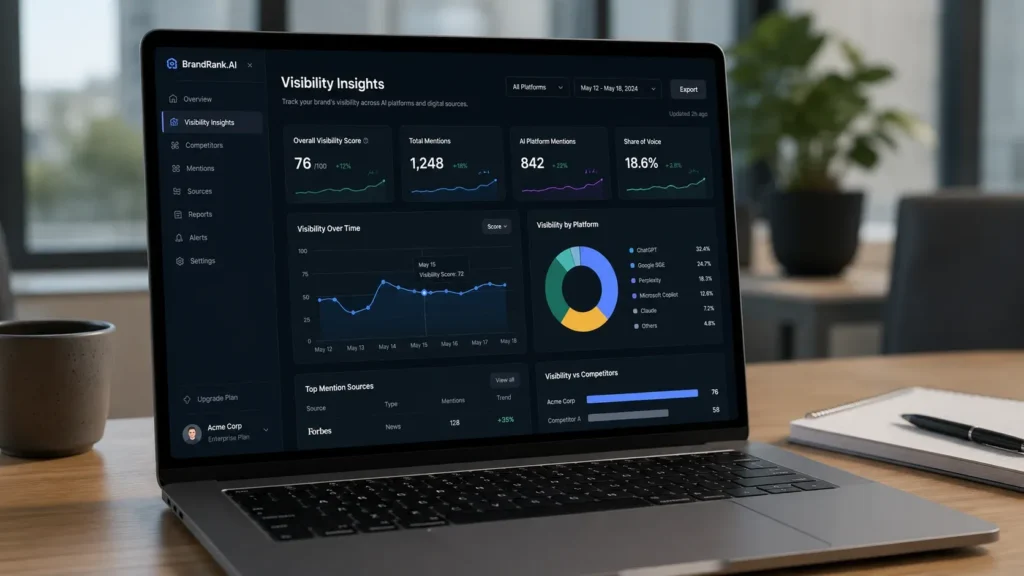
brandrank.ai visibility insights analysis is a SaaS platform built to track how a brand is represented inside AI-generated answers not traditional search rankings. Its visibility insights combine daily prompt testing, sentiment scoring, content readiness analysis, and competitive benchmarking across major AI answer engines including ChatGPT, Gemini, Claude, Perplexity, Grok, Meta.ai, and DeepSeek. In short: it tells you whether AI systems are recommending your brand, how they describe it, and what’s driving those outcomes data that traditional SEO tools can’t provide.
Why Visibility Insights Matter Now
Search behavior has quietly shifted. A growing share of product and service research now starts inside a conversation with an AI system rather than a traditional search engine results page. When someone asks ChatGPT or Perplexity “what’s the best CRM for a small agency” or “which skincare brand is best for sensitive skin,” the AI doesn’t return ten blue links it returns an answer, often naming two or three brands by name. If your brand isn’t one of them, you don’t just rank lower. You’re invisible to that customer entirely.
This is the core problem visibility insight platforms like BrandRank.AI are built to solve. Traditional SEO tells you where you rank on a results page. AI visibility analysis tells you whether you exist at all inside the answer and if you do, whether the AI is describing you accurately, positively, and in the right context.
What BrandRank.AI’s Visibility Insights Actually Measure
BrandRank.AI structures its analysis around three core measurable dimensions, supported by a defensive monitoring layer for reputational risk.
1. AI Search Visibility
This is the foundational metric: how often does your brand actually appear when AI engines answer relevant questions? The platform runs daily tests against a curated set of priority prompts questions real customers are likely to ask and tracks whether, where, and how often your brand shows up in the generated response. It also benchmarks that appearance rate against named competitors, so you can see not just your own visibility trend but your relative position in the category.
2. AI Content Readiness
Visibility isn’t only about whether you’re mentioned it’s about whether your existing content gives AI systems enough clear, structured, citable information to mention you accurately. This dimension evaluates how well your brand’s web presence aligns with what AI systems need to extract and cite: clear claims, structured data, authoritative sourcing, and content that directly answers the kinds of questions being asked. Gaps here often explain why a well-known brand still gets skipped over in AI answers in favor of a smaller competitor with clearer, more citable content.
3. Brand Risk Scoring
This layer focuses on vulnerability and accuracy flagging when AI systems misrepresent a brand, cite outdated information, surface negative sentiment, or omit context that matters (like discontinued products or resolved controversies still being referenced). For regulated industries such as financial services or CPG, this risk layer is often as important as the visibility metric itself, since AI-generated misinformation about a brand can spread across multiple platforms simultaneously.
4. Competitive Benchmarking
Layered across all three dimensions is market positioning analysis seeing exactly which competitors are winning the “prompted moments of truth” that your brand is losing, and on which specific queries. This turns the abstract idea of “AI visibility” into an actionable, prioritized list: which prompts to target, which competitors are outperforming you, and where the biggest visibility gaps sit.
How the Data Is Actually Collected
Unlike traditional search rank tracking, AI answer engines don’t provide public analytics dashboards showing who gets cited and how often. This makes independent measurement necessary and it’s the reason platforms like BrandRank.AI exist in the first place. The general methodology, consistent with how this category of tool operates, works roughly like this:
- Prompt selection: A set of priority queries relevant to the brand’s category and customer intent is defined mixing informational, commercial, and comparison-style prompts.
- Daily testing: Those prompts are run systematically against multiple AI engines to capture real generated responses, rather than relying on a single snapshot.
- Response parsing: Each response is analyzed for brand mentions, citation context, sentiment, and ranking position relative to competitors also mentioned.
- Scoring and aggregation: Results are converted into visibility scores, share-of-voice metrics, and trend lines that can be tracked over time and compared across platforms.
This approach mirrors what other players in the emerging Generative Engine Optimization (GEO) space including Profound, Ahrefs Brand Radar, and Similarweb’s AI Search Intelligence are also building toward, reflecting how quickly this category has formed since 2024–2025.
Reading a Visibility Insights Report: What the Numbers Mean
For teams new to this category, the terminology can be confusing at first. Here’s a breakdown of what the core metrics typically represent:
- Visibility Score: The percentage of relevant AI-generated answers in which your brand appears at all. A low score doesn’t necessarily mean poor brand quality it often means a content or citability gap.
- Share of Voice: Your visibility relative to competitors across the same prompt set a comparative, not absolute, measure.
- Average Rank/Position: Where your brand tends to appear when it is mentioned first-named brands typically carry more influence over the customer’s final decision.
- Sentiment Breakdown: Whether AI-generated mentions of your brand skew positive, neutral, or negative, along with recurring themes driving that sentiment.
- Topic Overlap: Which subjects or use cases your brand shares visibility with competitors on useful for identifying where competitive pressure is highest.
Who BrandRank.AI Is Built For
Based on the platform’s positioning, its tools are designed with a few distinct buyer profiles in mind, each with different priorities:
- Chief Marketing Officers and global brand leaders who need a board-level snapshot of how AI engines represent their brand across billions of daily prompts, and who need that data translated into a clear narrative for leadership.
- Marketing executives in regulated industries, such as financial services and consumer packaged goods, where reputational risk and compliance-sensitive accuracy in AI-generated answers carry outsized consequences.
- Established enterprise brands working to defend an existing market position against erosion in AI-driven consideration sets, where competitors with sharper AI-ready content could otherwise chip away at mindshare.
- Challenger brands, DTCs, and agile marketing teams who may not have the largest budgets but can move quickly to close specific visibility gaps once they’re identified.
This range of buyer types explains why the platform structures its plans around tiers a lighter-weight offering aimed at smaller or faster-moving teams, and a more comprehensive enterprise-level offering built around ongoing strategic support.
Plan Structure and What’s Typically Included
While exact pricing for platforms in this category is usually only available through a custom quote, the general plan structure tends to follow a two-tier model common across enterprise SaaS tools:
- An entry-level tier (often positioned for challenger brands and smaller marketing teams) typically includes daily AI search visibility tracking, AI content readiness scoring, brand risk scoring, and competitive benchmarking, along with a modest number of user seats enough for a focused marketing or brand team to collaborate directly.
- A premium or enterprise tier typically builds on the entry-level feature set with a full audit of AI visibility, scheduled strategic reviews with an account team, and structured growth recommendations aimed at organizations that want ongoing expert guidance layered on top of the raw data, along with a larger user seat allocation to support cross-functional brand, PR, and communications teams working from the same dashboard.
For most organizations evaluating this category for the first time, the practical question isn’t which tier to buy immediately it’s whether the underlying visibility data reveals a large enough gap to justify the investment. A short diagnostic period focused on a handful of priority prompts is often enough to answer that question before committing to a broader rollout.
Real-World Use Cases
- Enterprise CMOs use visibility insights to justify investment in AI-focused content strategy by showing board-level stakeholders concrete before/after visibility data.
- Regulated industry marketers (financial services, CPG) use the risk-scoring layer to catch and correct AI-generated misinformation before it spreads further.
- Challenger brands and DTC companies use competitive benchmarking to identify specific prompts where they can realistically overtake a larger competitor’s AI visibility.
- Content and SEO teams use content readiness scoring to prioritize which pages need restructuring for better AI citability, rather than guessing.
Expert Analysis: Why This Category Is Growing So Fast
The rapid emergence of AI visibility platforms reflects a broader shift industry analysts have been tracking closely: AI answer engines are increasingly functioning as the first, and sometimes only, research step in a purchase journey. Once a customer receives a confident, well-reasoned answer from an AI system, the incentive to click through to a traditional search results page and compare options manually drops significantly. Brands that fail to show up favorably inside that AI-generated answer effectively lose the customer before a traditional website visit ever happens.
This has turned AI visibility from a niche marketing curiosity into what several analysts now describe as a board-level topic — comparable to how organic search rank tracking became a standard reporting metric in the 2000s and 2010s.
It also explains why a small but growing cluster of specialized vendors has emerged almost simultaneously — including Profound, Ahrefs Brand Radar, Similarweb’s AI Search Intelligence, and platforms like BrandRank.AI. None of these tools existed in their current form more than a couple of years ago, which is itself a signal of how quickly the underlying customer behavior has shifted. Marketing teams that treat this as a passing trend risk being caught flat-footed once competitors with stronger AI visibility start capturing disproportionate consideration in categories where the buying decision increasingly starts and ends inside a single AI conversation.
Pros & Cons of Using a Visibility Insights Platform
| Pros | Cons |
| Reveals visibility data unavailable through any public AI engine dashboard | Category is new — methodologies and scoring models vary across vendors |
| Combines visibility, content readiness, and risk into one workflow | Daily prompt-based sampling can’t capture every possible customer query |
| Enables direct competitive benchmarking on AI-generated answers | Requires ongoing content investment to meaningfully move the scores |
| Surfaces misinformation or outdated brand references early | Pricing tends to be positioned toward enterprise budgets |
Comparison Table: Visibility Insight Dimensions
| Dimension | What It Measures | Why It Matters |
| AI Search Visibility | Frequency and ranking of brand mentions across AI engines | Shows whether you exist in the customer’s AI-generated answer at all |
| Content Readiness | Alignment of your content with what AI systems need to cite you | Explains why visibility is high or low |
| Brand Risk Scoring | Accuracy and sentiment of AI-generated brand mentions | Protects against misinformation and reputational drift |
| Competitive Benchmarking | Relative positioning against named competitors | Turns visibility data into prioritized action |
Key Takeaways
- AI visibility insights measure something fundamentally different from traditional SEO rank tracking: presence and framing inside AI-generated answers, not page position.
- BrandRank.AI’s model rests on three pillars — search visibility, content readiness, and brand risk — layered with competitive benchmarking.
- Because AI engines don’t expose public citation analytics, third-party daily prompt testing is currently the only practical way to measure this data.
- This category is moving quickly from “nice to have” to a standard marketing reporting requirement, particularly for enterprise and regulated brands.
Common Mistakes Brands Make
- Assuming strong traditional SEO rankings automatically translate into strong AI visibility — the two are correlated but not the same.
- Ignoring the content readiness dimension and focusing only on the visibility score, without addressing the underlying content gaps causing it.
- Treating a single low-visibility snapshot as a definitive result, rather than tracking trends over time across a representative prompt set.
- Failing to monitor sentiment and accuracy, which can allow AI-generated misinformation about a brand to go unnoticed for months.
Best Practices for Improving AI Visibility
- Structure content to directly and clearly answer the specific questions customers are likely to ask AI systems, rather than optimizing purely for keyword density.
- Prioritize authoritative, well-sourced claims — AI systems favor content they can confidently cite without ambiguity.
- Monitor sentiment and factual accuracy regularly, not just presence, since being mentioned negatively or inaccurately can be worse than not being mentioned at all.
- Use competitive benchmarking data to focus content efforts on the specific prompts where competitors are currently winning, rather than spreading effort evenly.
Conclusion
As AI answer engines increasingly become the starting point for product and brand research, visibility insights platforms like BrandRank.AI are filling a measurement gap that traditional SEO tools were never built to address. The real value isn’t just knowing whether your brand gets mentioned — it’s understanding why, how accurately, and against which competitors, so that marketing and content teams can act on clear priorities rather than guesswork. For any brand serious about staying relevant in an AI-first discovery landscape, visibility insight data is quickly becoming as essential as organic search analytics once were.
FAQs
What does BrandRank.AI actually track?
It tracks how often, where, and how favorably a brand appears in AI-generated answers across engines including ChatGPT, Gemini, Claude, Perplexity, Grok, Meta.ai, and DeepSeek, using daily prompt testing.
How is this different from traditional SEO tracking?
Traditional SEO tracks where a page ranks on a search results page. AI visibility insights track whether and how a brand is mentioned inside a generated answer a fundamentally different kind of visibility that traditional rank trackers can’t capture.
Who typically uses AI visibility insights platforms?
Enterprise marketing leaders, brand teams in regulated industries, challenger and DTC brands, and content/SEO teams looking to prioritize AI-citability improvements.
Can a brand with strong SEO still have poor AI visibility?
Yes. Strong traditional search rankings don’t guarantee AI citability AI systems weigh clarity, structure, and authoritative sourcing differently than traditional search algorithms do.
How often is visibility data updated?
Platforms in this category, including BrandRank.AI, generally run prompt tests daily to capture visibility trends rather than relying on single point-in-time snapshots.